

A Tale of Two Odd Moons
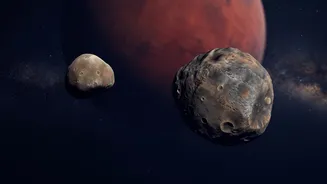
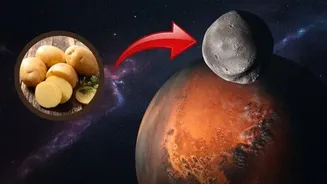
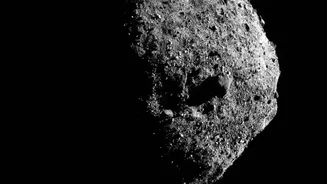
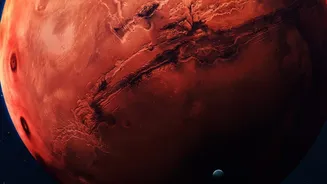
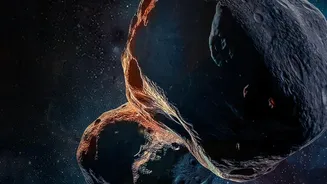
Unlike Earth’s large, spherical Moon, the moons of Mars are cosmic potatoes. Phobos, the larger of the two, is just 27 kilometres across at its widest point, while Deimos is even smaller. They are among the smallest moons in the solar system. Their odd,
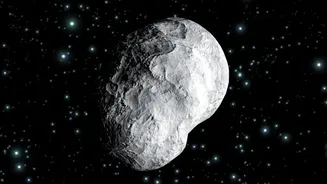
non-spherical shapes and dark surfaces made them look a lot like the carbon-rich asteroids found in the outer asteroid belt. For decades, this visual evidence formed the basis of the leading theory about their origin. But there was always a problem with this idea, one that was hidden in the way they moved.
The Captured Asteroid Story
The simplest explanation was that Phobos and Deimos were once asteroids, zipping through the solar system until they strayed too close to Mars and were ensnared by its gravity. This 'capture theory' was appealing in its simplicity. However, the physics just doesn't quite work. When an object is captured by a planet's gravity, it typically ends up in a strange, elliptical, and tilted orbit. Phobos and Deimos, however, have nearly perfect circular orbits that lie almost exactly on Mars's equatorial plane. It would require an incredible amount of cosmic luck for two captured asteroids to settle into such orderly paths. This orbital problem has long been a major thorn in the side of the capture theory, leading many scientists to look for a more dramatic explanation.
The Giant Impact Theory Takes Over
The leading alternative is far more violent and is now widely considered the frontrunner. The 'giant impact hypothesis' suggests that the moons were born from Mars itself. According to this model, a massive object—perhaps the size of a large asteroid like Vesta or a dwarf planet like Ceres—slammed into a young Mars billions of years ago. The catastrophic collision would have ejected a massive amount of rock and debris from the Martian surface, forming a spinning ring around the planet. Over time, the material in this ring would have clumped together under its own gravity, eventually forming one or more moons. This story is similar to the leading theory for how Earth's own Moon formed, suggesting it could be a common process for terrestrial planets.
New Research Sharpens the Focus
Recent research has added compelling new layers to the giant impact theory, helping to solve some of its own puzzles, like why the moons are so small. One updated model suggests that the impact initially formed a single, larger moon. This moon was then torn apart, possibly by Mars's gravity, and from its debris, Phobos and Deimos were born. This would explain why we see two small bodies instead of one large one. Furthermore, a 2024 study has helped to date this cataclysmic event, suggesting the impact likely happened between 1 and 2.7 billion years ago. Spectrographic data from probes like the Mars Express have also shown that the composition of Phobos doesn't quite match known asteroid types, lending more weight to the idea that it is made of Martian material.
A Mission for the Final Answer
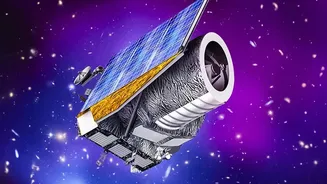
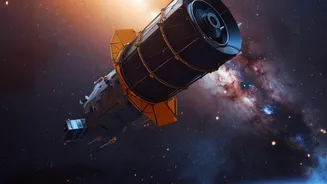
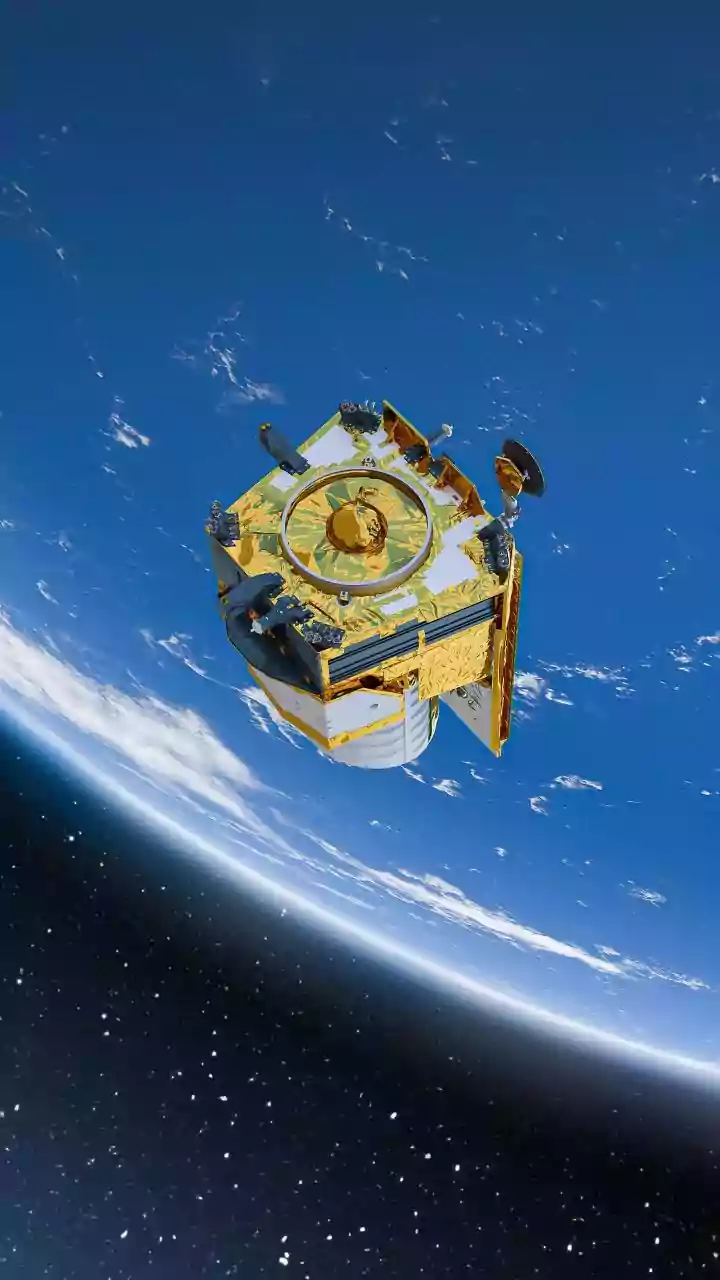
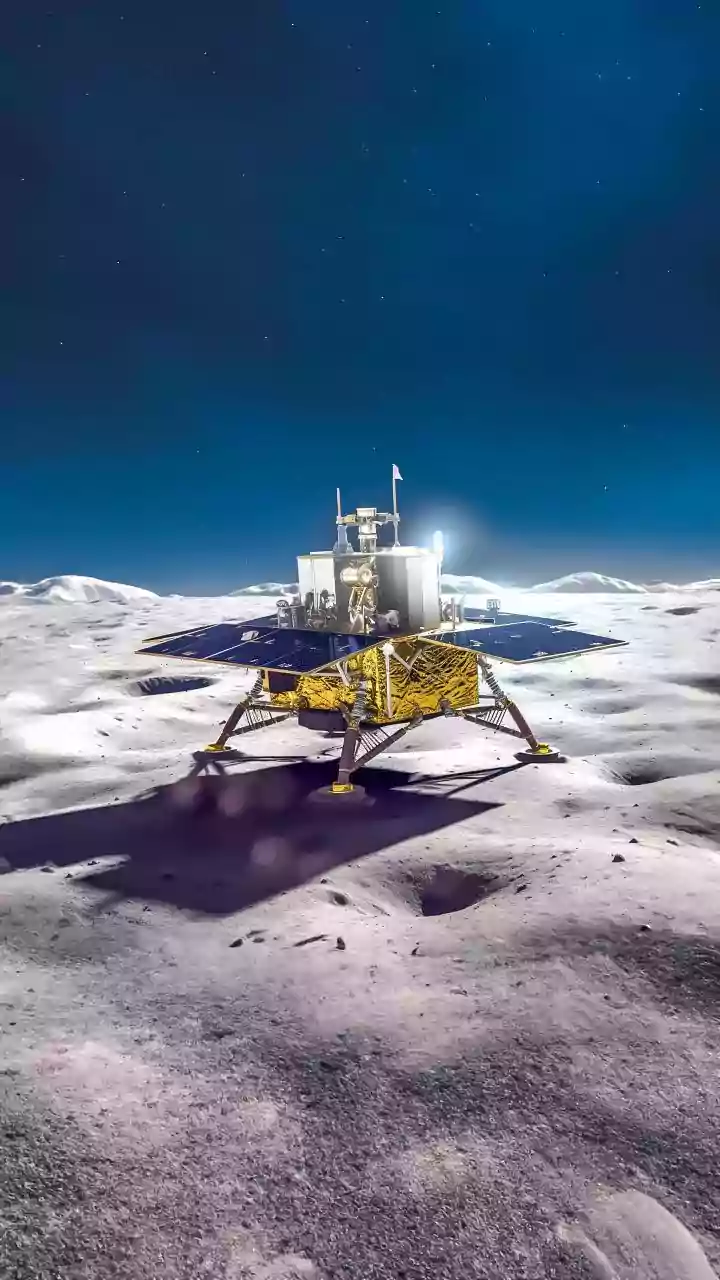
While simulations and remote analysis have built a strong case, the final proof is still missing. To get it, we need a piece of Phobos itself. That's the goal of the upcoming Martian Moons eXploration (MMX) mission from the Japan Aerospace Exploration Agency (JAXA). Scheduled to launch in 2026, the MMX spacecraft will travel to the Martian system, orbit both moons, and, most importantly, land on Phobos to collect a sample of its surface. This sample will then be returned to Earth for analysis. By studying the rock and dust from Phobos in labs here, scientists will be able to determine its age and composition with incredible precision. This will allow them to say definitively whether it is made from the same material as Mars or if it comes from somewhere else in the solar system, finally solving the long-standing mystery.