





A 'New Star' in the Heavens
When the mysterious light appeared in the constellation Ophiuchus, the telescope had not yet been invented. Observers relied solely on the naked eye. At its peak, the 'new star' was so bright it was visible during the day for over three weeks. Johannes
Kepler, though not the first to see it, began a meticulous year-long study. His detailed work, 'De Stella Nova' ('On the New Star'), was so comprehensive that the event became forever linked with his name. For 17th-century thinkers, this event was a profound challenge to the long-held Aristotelian idea of perfect, unchanging heavens. The appearance of a new star proved that the cosmos was a dynamic and evolving place.
What Kepler Actually Saw
Today, we know that Kepler and his contemporaries were not watching the birth of a star, but its violent death. What they observed is now classified as a Type Ia supernova. This kind of cosmic explosion happens in a binary star system, where two stars orbit each other. One of the stars is a white dwarf—the small, dense core left behind by a star like our sun. This white dwarf's powerful gravity pulls material from its companion star. When the white dwarf accumulates too much mass, it reaches a critical point and triggers a runaway thermonuclear explosion, shattering itself in the process. The resulting blast is one of the most luminous events in the universe.
Four Centuries of Cosmic Expansion
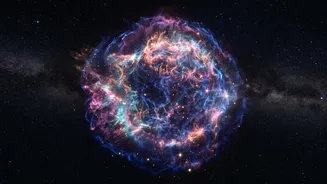
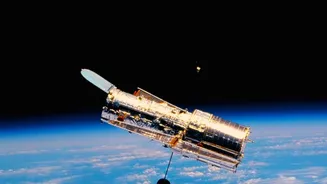
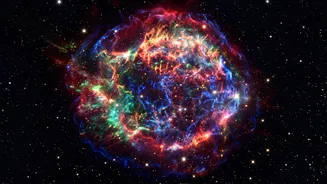
After fading from view in 1606, the aftermath of the explosion sat quietly in space for centuries. The remnant—an expanding cloud of gas and dust—was only rediscovered in 1941 as a very faint nebula. It took the dawn of the space age and the development of powerful new observatories to truly unlock its secrets. While optical telescopes like the Hubble Space Telescope can see parts of the remnant, the most crucial information comes from wavelengths invisible to the human eye, particularly X-rays. The material in a supernova remnant is heated to millions of degrees by the blast wave, causing it to glow brightly in X-ray light.
A New View Through X-Ray Eyes
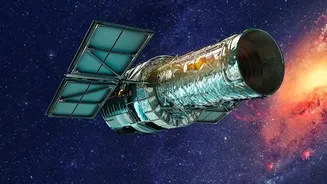
Enter NASA's Chandra X-ray Observatory. By studying the X-rays emanating from Kepler's Supernova Remnant, astronomers have been able to piece together the story of the explosion in stunning detail. Chandra's observations reveal a bubble-shaped shroud of iron-rich material, now about 14 light-years wide, blasting outward into space. This shell is expanding at an incredible speed, with some knots of debris clocked at over 20 million miles per hour. The X-ray data allows scientists to map the distribution of different elements within the debris, confirming the explosion originated from a white dwarf and not a more massive star. By combining data from Chandra (X-ray), Hubble (optical), and the Spitzer Space Telescope (infrared), scientists can create a composite view, tracing everything from the hottest, fastest-moving particles to the cooler dust being swept up by the shock wave.
An Ongoing Cosmic Investigation
Located roughly 20,000 light-years from Earth, SN 1604 remains the last supernova known to have been observed within our own Milky Way galaxy. Modern studies continue to refine our understanding of the event. Data collected by Chandra over more than two decades allows astronomers to watch the remnant expand in what amounts to a time-lapse video, providing unprecedented insight into the dynamics of a supernova's aftermath. Even 400 years later, the remnant of Kepler's star serves as a unique cosmic laboratory. It not only helps us understand the life cycle of stars but also provides crucial information about Type Ia supernovae, which are used by astronomers as 'standard candles' to measure the expansion of the universe itself.