


Our Solar System's Protective Shield
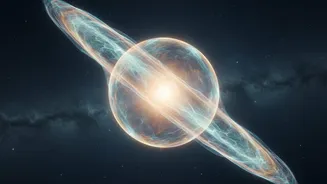
Imagine our entire solar system, from the Sun to beyond Pluto, enclosed in a giant bubble. This isn't science fiction; it's the heliosphere. It’s formed by a constant stream of charged particles flowing from the Sun, known as the solar wind. This wind travels
outwards at immense speeds, pushing back against the matter and radiation that fills the space between stars, known as the interstellar medium. This bubble acts as a crucial shield, protecting all the planets, including Earth, from a significant amount of dangerous galactic cosmic rays. Without the heliosphere, life on our planet might have evolved very differently, if at all. It creates a habitable region in our corner of the galaxy, making it a subject of intense scientific interest.
Meet NASA's New Cosmic Cartographer
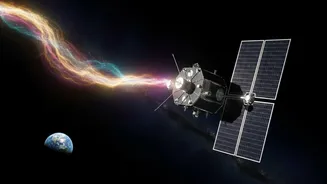
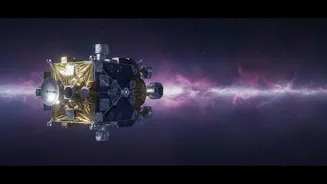
Enter the Interstellar Mapping and Acceleration Probe, or IMAP. Launched in September 2025, this cutting-edge NASA mission is designed to be our generation's great cosmic cartographer. Its primary job is to create the first comprehensive maps of the heliosphere's boundaries. Positioned about 1.5 million kilometres from Earth towards the Sun, at a gravitationally stable spot called Lagrange Point 1, IMAP has a perfect vantage point. The spacecraft is equipped with ten sophisticated instruments, each designed to study different aspects of our space environment. Several of these instruments are designed to detect 'energetic neutral atoms' (ENAs). These particles are created at the edge of the solar system and, because they have no electric charge, travel in straight lines, carrying information directly from the distant boundary. By capturing these particles, IMAP can trace their origins and build a picture of a region that is otherwise invisible.
The First Glimpse of the Boundary
In a major milestone, NASA has now made the first batch of science data from seven of IMAP's ten instruments publicly available. This initial release, covering the first few months of the mission's operations, offers scientists and the public a preliminary look at the measurements that will eventually form the most detailed map of the heliosphere ever created. The available data includes measurements of the interplanetary magnetic field from the MAG instrument and observations of solar wind particles from the SWAPI instrument. While the complete, high-resolution maps will take more time to assemble, this first data drop is a crucial step. It confirms the instruments are working as expected and are successfully gathering the raw material—the countless particle detections—needed to chart the shape, structure, and dynamics of our solar system's shield with unprecedented detail.
Why This Cosmic Map Matters
Mapping the heliosphere isn't just an academic exercise; it has profound practical implications. A better understanding of this boundary helps us comprehend how our solar system interacts with the rest of the galaxy. Crucially, IMAP also functions as an advanced space weather monitoring station. Its instruments can provide about a half-hour warning of incoming solar energetic particles, which can be harmful to satellites, power grids on Earth, and especially astronauts in space. This real-time data, streamed through a system called I-ALiRT, is already being used by forecasters at NOAA's Space Weather Prediction Center to improve the timeliness and accuracy of space weather alerts. For future deep-space missions, like journeys to Mars, knowing the radiation environment outside our planetary system is essential for astronaut safety.
The Journey Ahead for IMAP
This first data release is just the beginning of IMAP's journey. The mission is planned to last for several years, during which it will continuously scan the sky, collecting particles from every direction to build up its maps. Scientists are eager to answer fundamental questions, such as the true shape of the heliosphere—long thought to be comet-shaped, but now suspected to be more spherical or even croissant-like. IMAP's data will build upon the legacy of previous missions like Voyager and the Interstellar Boundary Explorer (IBEX) but will provide a much clearer and higher-resolution picture. As the probe continues its silent watch, it will not only map our home in the galaxy but also help unlock secrets about how stars interact with their galactic environments across the universe.