

The Search for Water Worlds
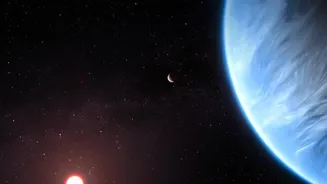
For decades, astronomers have been scanning the cosmos for exoplanets—planets orbiting stars other than our Sun. The ultimate goal is to find a world like our own, capable of supporting life. A key ingredient for life as we know it is liquid water. To
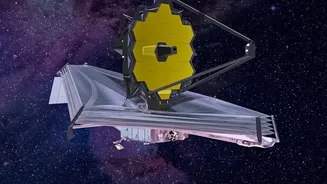
find it light-years away, scientists use powerful tools like the James Webb Space Telescope (JWST) to perform what's called transmission spectroscopy. When an exoplanet passes in front of its star from our point of view, a tiny fraction of the starlight filters through the planet's atmosphere. Different molecules in the atmosphere absorb light at specific wavelengths, leaving a unique chemical fingerprint in the light that reaches our telescopes. A strong signal at the right wavelength can suggest the presence of water vapour, a thrilling prospect for scientists.
A Stellar Case of Mistaken Identity
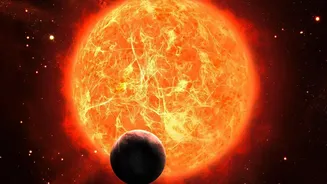
However, recent studies have highlighted a cosmic complication. The host star itself can be a source of confusion. Many stars, particularly the cool, dim red dwarfs that are common in our galaxy, are not uniform spheres of light. Their surfaces are mottled with starspots—large, cooler, and darker patches caused by intense magnetic activity, much like the sunspots on our own Sun. This stellar activity can create a false positive, tricking astronomers into thinking they've detected water in a planet's atmosphere when none might be there. The phenomenon is known as the "transit light source effect," and it presents a significant hurdle in accurately characterizing distant worlds.
How the Illusion Works
The deception occurs because of the temperature difference between the star's main surface and its cooler starspots. Water molecules can actually exist in the cooler layers of the star's own photosphere. When a planet transits, astronomers compare the light blocked by the planet to the light of the unblocked star. If the planet happens to cross in front of a large, cool starspot, it's blocking a region that is dimmer and has a different light spectrum than the rest of the star. This difference in the starlight's colour and intensity can create a signal that precisely mimics the signature of water in the planet's atmosphere. It becomes difficult to tell whether the water signature is from the planet or the star itself.
A Real-World Conundrum
This isn't just a theoretical problem. When observing the rocky super-Earth GJ 486 b, located 26 light-years away, JWST detected a signal that could have been water vapour in the planet's atmosphere. This was an exciting possibility, suggesting an atmosphere could survive intense radiation from its nearby star. However, the team also acknowledged the ambiguity: the signal could have been caused by water in cool spots on the host star. Follow-up observations at different wavelengths suggested the planet is more likely a bare rock, and the water signature originated from the star. This case illustrates how stellar contamination is a real and present challenge that must be carefully considered in the quest for habitable worlds.
Sharpening Our Cosmic Vision
Rather than being a setback, this discovery is making the science of exoplanet hunting more robust. Astronomers are developing sophisticated methods to disentangle the planetary and stellar signals. NASA's Pandora mission, for instance, is specifically designed to address this problem by observing stars and planets simultaneously in different light wavelengths to separate the two signals. By creating more complex models of stars and accounting for their spots and other magnetic activity, scientists can better correct for this contamination. It’s a painstaking process of refining techniques and ruling out impostors. This meticulous work ensures that when a definitive detection of water is announced, the scientific community can be much more confident that it's the real thing, bringing us one step closer to answering the question of whether we are alone in the universe.