


The Classic Tale of the Moon's Birth
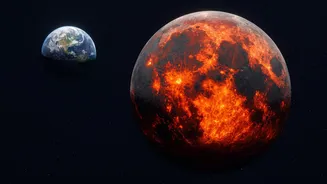
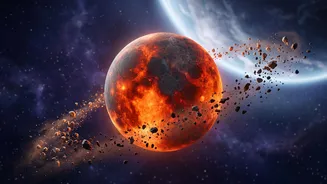
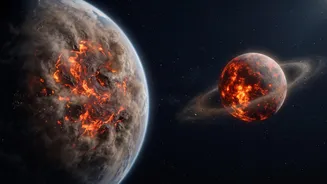
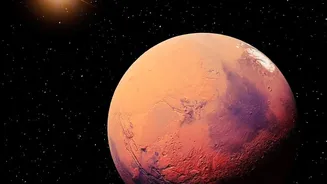
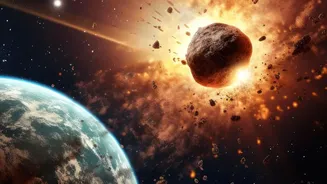
For many years, the leading scientific narrative for the Moon's formation has been the Giant-Impact Hypothesis. This theory proposes that about 4.5 billion years ago, a young, still-forming Earth was struck a glancing blow by a Mars-sized object dubbed
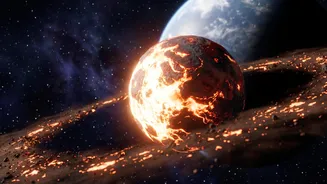
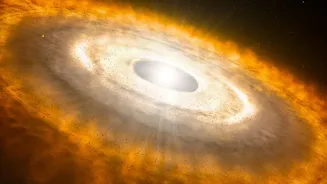
Theia. The colossal collision would have ejected a massive cloud of molten rock and debris into space. According to this model, that debris formed a ring around our planet and, over thousands or even millions of years, slowly clumped together through gravity to form the Moon we see today. This story elegantly explained many things, including the Moon's size and its lack of a large iron core like Earth's.
A Glaring Inconsistency
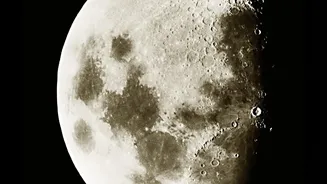
Despite its strengths, the Giant-Impact Hypothesis has a major flaw that has troubled scientists for years, often called the 'isotopic crisis'. When Apollo astronauts brought back rock samples from the Moon, analysis revealed a startling fact: the Moon's chemical and isotopic makeup is remarkably similar to that of Earth's mantle. If the Moon was formed mostly from the debris of a foreign body, Theia, it should have a distinct chemical signature. But it doesn't. This Earth-like composition suggests the Moon is made primarily of Earth material, a fact that the classic debris-disk model struggles to explain, as most simulations showed the disk would be composed mostly of Theia's remnants.
A New, High-Speed Origin Story
A compelling new theory, powered by cutting-edge supercomputer simulations, offers a dramatic alternative. Instead of a slow coalescence, what if the Moon formed almost instantly? Researchers at institutions like NASA and Durham University have run some of the most detailed simulations of this ancient impact ever created. These high-resolution models show a scenario where the collision was so violent that a massive chunk of Earth's mantle was blasted directly into a stable orbit and pulled itself together into a cohesive body in a matter of hours, not millennia.
What the Supercomputer Evidence Shows
Previous simulations were run at lower resolutions, which meant they could miss crucial details of the collision's physics. The new models, using hundreds of millions of simulated particles, provide a much clearer picture. These simulations, run on high-performance computing facilities like DiRAC, show that under certain impact conditions, a large, intact, Moon-like body can be formed immediately. This satellite is launched beyond the point where Earth's gravity would tear it apart, known as the Roche limit, allowing it to survive and settle into orbit. A recent 2026 study even suggests the temperature and strength of the planetary rock at the time of impact could be the key factor determining if a debris disk or an intact Moon was formed, with some scenarios pointing to a five-hour formation time.
Solving Long-Standing Lunar Mysteries
This rapid, single-stage formation theory provides an elegant solution to the isotopic crisis. If the Moon is essentially a piece of Earth that was violently thrown into space, its composition would naturally be almost identical to our planet's mantle. This new model also helps explain other odd features of the Moon, such as its tilted orbit, which doesn't align perfectly with Earth's equator. Furthermore, by forming so quickly, the Moon's interior may not have become entirely molten, which could align better with what we know about its thin crust. While not definitively proven, the rapid-formation scenario offers a cleaner explanation for several of the Moon's biggest puzzles.