



The Cosmic Rule-Breaker
Imagine the universe as a collection of vast, spinning cities of stars, gas, and dust. At the heart of nearly every major city, or galaxy, lies a monstrous, gravitational anchor: a supermassive black hole. These objects, millions or billions of times
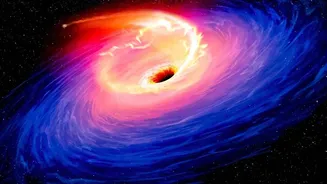
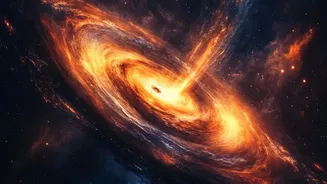
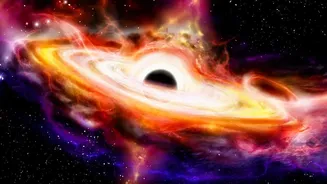
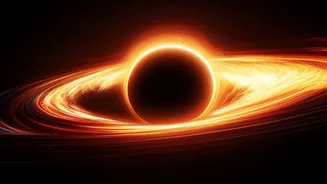
the mass of our sun, are the galactic standard. Their immense gravity dictates the motion of stars and provides the central point around which the entire galaxy revolves. This is one of the fundamental principles of modern astronomy. That’s why scientists were stunned to find a supermassive black hole that isn't at home. NASA's Neil Gehrels Swift Observatory helped confirm the existence of a black hole weighing around one million suns, not in the bustling downtown of its galaxy, but wandering in the quiet suburbs, more than 30,000 light-years from the core. This discovery was made in a fascinating way: the black hole, previously dormant and invisible, revealed itself when it tore apart and devoured a passing star, creating a brilliant flare of light known as a tidal disruption event.
A Tale of Galactic Violence
So, how does a beast as massive as a supermassive black hole end up so far from its rightful place? The leading theory is a story of immense cosmic violence: a galaxy merger. Galaxies are not static; they move, they evolve, and sometimes, they collide. When two galaxies merge, their central black holes will eventually begin to orbit each other, locked in a gravitational dance. Over millions of years, they spiral closer and closer, eventually combining to form one larger black hole. The process is one of the most energetic events in the universe, second only to the Big Bang itself. However, this merger is rarely perfectly symmetrical. If the two original black holes have different masses, or are spinning at different rates or in different directions, the collision gets messy.
The Gravitational Kick
The asymmetrical merger of two supermassive black holes unleashes a colossal blast of energy in the form of gravitational waves—ripples in the fabric of spacetime itself. If these waves are radiated more strongly in one direction, the universe, in keeping with Newton's third law, gives the newly formed black hole a powerful 'kick' in the opposite direction. This phenomenon, known as a gravitational wave recoil, can be incredibly powerful. Depending on the specifics of the merger, the kick can send the new black hole flying at speeds of millions of miles per hour, potentially fast enough to escape its host galaxy's core entirely. What we are likely seeing with this off-center black hole is the aftermath of such an event—a cosmic giant booted from its throne.
Swift's Crucial Role
Finding these wandering black holes is incredibly difficult. Since they don't emit light on their own, they are usually invisible. The only way to spot one is to catch it in the act of feeding. This is where the Neil Gehrels Swift Observatory comes in. Originally designed to hunt for gamma-ray bursts, Swift's agility is its greatest asset. When another telescope, the Zwicky Transient Facility, detected a strange flash in an unexpected part of a galaxy, Swift was able to quickly re-orient itself to observe the event in X-ray and ultraviolet light. These multi-wavelength observations confirmed the flare wasn't a supernova but had the distinct signature of a star being shredded by a black hole, allowing astronomers to calculate the black hole's mass and confirm its supermassive nature. Without Swift's rapid response and versatile instruments, this rogue giant could have remained hidden.