




The Arctic's Cloud Conundrum
The Arctic atmosphere is one of the cleanest on the planet. Logically, this should mean fewer clouds, because cloud droplets need tiny particles—like dust, salt, or soot—to form around. These particles are known as cloud condensation nuclei (CCNs), or cloud seeds.
Without them, water vapor has nothing to condense onto. Yet, scientists have long observed that the Arctic has more cloud cover than expected, particularly in the summer. This has been a persistent puzzle in climate models. These clouds play a dual role: they can reflect sunlight back into space, creating a cooling effect, but they can also trap heat radiating from the surface, acting like a blanket and warming the region, especially during the long, dark Arctic winter. Understanding what drives cloud formation here is critical to predicting the future of Arctic—and global—climate.
A Surprising Finding at the Ice's Edge
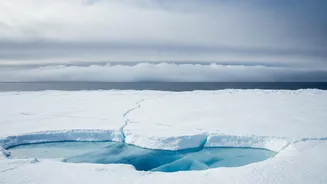
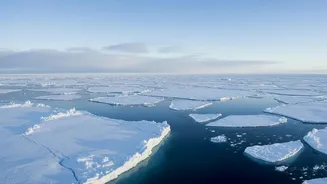
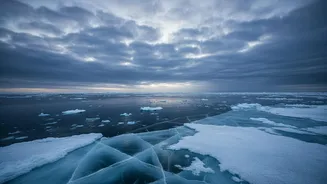
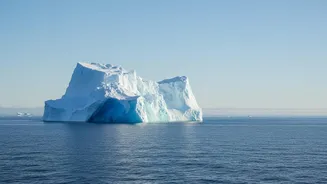
A recent study published in Nature Geoscience has shed new light on this mystery. An international team of researchers found that the marginal ice zone—the dynamic boundary where sea ice meets the open ocean—is a surprisingly powerful source of cloud-seeding particles. As the ice melts, it exposes ocean water rich in marine algae to sunlight. This triggers the release of a specific chemical cocktail, including iodine, sulphur, and organic compounds, into the atmosphere. Under the influence of sunlight, these gases undergo chemical reactions to form brand-new aerosol particles in a process called new particle formation.
From Tiny Specks to Potent Cloud Seeds
What truly surprised researchers was the speed and scale of this process. The study provided real-world evidence that these newborn particles grow incredibly quickly. Scientists observed that the number of particles large enough to seed clouds could increase by as much as 50 times in a single day near the ice edge. In one case, the concentration of these particles jumped from around 50 to 1,500 per cubic centimetre. This rapid growth is fueled by a newly identified class of compounds called iodine-containing oxygenated organic molecules (I-OOMs). These compounds act like a superfood for the tiny particles, helping them bulk up to the size needed to form cloud droplets much faster than previously thought possible.
A Complicated Climate Feedback Loop
This discovery reveals a complex and powerful climate feedback loop. As the planet warms, more Arctic sea ice melts, exposing more of the marginal ice zone. This, in turn, creates more of these fast-growing particles, leading to more, or brighter, clouds. The ultimate impact, however, is not straightforward. More clouds during the sunlit summer could reflect more solar radiation, potentially slowing down the warming of the open ocean. However, an increase in cloud cover could also trap more heat, accelerating the melting of the remaining sea ice. Which effect dominates is a crucial question that scientists are now working to answer, as it has major implications for the rate of future Arctic warming.
Why the Arctic Matters to India
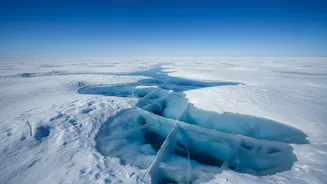
What happens in the Arctic doesn't stay in the Arctic. The region's rapid warming has profound consequences for the rest of the world, including India. The melting of the vast Greenland ice sheet and Arctic glaciers is a primary driver of global sea-level rise, posing a direct threat to India's extensive coastline and major cities like Mumbai and Kolkata. Furthermore, changes in the Arctic can disrupt global atmospheric circulation patterns, including the jet stream. This can have downstream effects on weather systems around the world, and scientists are actively researching how these changes might influence the stability and intensity of the Indian monsoon, which is the lifeblood of the subcontinent's agriculture and economy.