






A Postcard from a Puzzling Planet
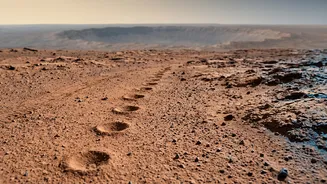
While climbing through a region known as Valle Grande on the slopes of Mount Sharp, the Curiosity rover stumbled upon a peculiar sight: a series of small, shallow divots in the bedrock. One of the most clearly photographed holes measures just about one
centimetre across. For a rover that has been exploring Gale Crater for over 14 years, encountering pits is nothing new on a planet scarred by meteorite impacts and geological activity. But these particular holes immediately stood out to the mission's science team as something different, prompting a closer look.
What Makes These Holes So Strange?
The primary mystery lies in how these holes differ from previously observed features. Typically, small pits in Martian rock are formed when a harder pebble or mineral nodule, embedded in softer surrounding rock, eventually weathers away, leaving a cavity behind. However, the newly discovered holes are unusually broad and shallow, and crucially, there are no obvious pebbles or nodules nearby that look as if they once filled these depressions. This lack of a clear culprit is what makes the finding so intriguing. As one NASA scientist involved with the mission noted, after so many years on the surface, Mars continues to find new ways to be surprising.
The Hunt for a Geological Explanation
With the most common explanation not fitting the evidence, scientists are now considering other possibilities. The answer is believed to be geological, not biological, but the exact mechanism remains elusive. The holes could be the result of a unique erosion process not yet seen by the rover, or perhaps a specific property of this particular rock layer. The area where the holes were found is already of great interest. Curiosity is ascending Mount Sharp, a 5.5-kilometre-high mountain whose sedimentary layers preserve a record of Mars' changing climate and environment over billions of years. These pits could reveal new information about the conditions under which these rock layers were formed or transformed.
Using Rover Tech to Solve the Mystery
To get to the bottom of it, the Curiosity team is using the rover's advanced imaging tools. The Mars Hand Lens Imager (MAHLI) has been used to take detailed, close-range photographs of the pits. At the same time, the rover's Mastcam cameras have captured overlapping stereo images of the surrounding terrain. By combining these images, scientists on Earth can create detailed three-dimensional models of the surface. These models will allow them to precisely measure the shape and depth of the holes, which could provide critical clues to help them work backwards and determine how they were formed. Further analysis of the surrounding rock's chemistry is also underway, though processing this data will take time.
Part of a Larger Martian Puzzle
These strange holes are not the only recent mystery to emerge from Valle Grande. A few weeks prior, the rover discovered a vast expanse of honeycomb-like polygonal fractures, a pattern seen before but never on such a massive scale. Scientists believe those patterns may have been formed by drying mud or extreme temperature cycles billions of years ago. While there's no stated connection between the polygons and the new holes, their proximity in this relatively new territory for the rover highlights just how much is left to discover. Each new, unexplained feature serves as a tantalizing breadcrumb in the story of how Mars transformed from a world that once had water to the cold, dry planet we see today.