






A Geological Ghost Story
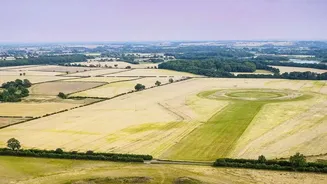
Imagine a volcano so vast its eruption was one of the largest in Earth's history, blasting ash across an ancient sea to settle in what is now Scandinavia. Now, imagine this titan is hiding, completely invisible, under the serene countryside of Norfolk
and Lincolnshire. This isn't science fiction; it's the result of painstaking geological detective work that has confirmed the existence of a massive volcanic system, centred beneath The Wash, that was active around 454 million years ago. It belongs to an era long before the dinosaurs, when the landmass that would become England was part of a microcontinent called Avalonia, located near an active tectonic plate boundary. Unlike the rugged volcanic landscapes preserved in Wales' Eryri National Park or the Lake District, this eastern giant was buried and eroded over hundreds of millions of years, its story waiting to be pieced together.
The Key in the Crystals
The secret to identifying this ghost volcano wasn't found by digging for a crater, but by looking at something much smaller: tiny crystals recovered from boreholes decades ago. Scientists from the British Geological Survey (BGS) and the University of Oslo re-examined rock samples drilled in the 1940s from North Creake in Norfolk and Claxby in Lincolnshire, locations roughly 65 kilometres apart. Within these samples were zircon crystals, minerals smaller than the diameter of a human hair that form in molten magma. Zircon acts as a perfect geological clock. It contains trace amounts of uranium, which decays into lead at a precisely known rate. By using modern, high-precision dating techniques on these old samples, scientists could pinpoint the exact moment the crystals formed.
Connecting a 454-Million-Year-Old Puzzle
The analysis yielded a stunning result: the zircon crystals from both English borehole sites were dated to approximately 454.4 million years ago. This proved they came from the same massive volcanic event. But the discovery went further, solving a long-standing European geological mystery—the origin of the Kinnekulle tephra. The Kinnekulle tephra is a thick layer of volcanic ash found across Norway, Sweden, the Baltic region, Belarus, and Poland. For decades, its source was unknown. Scientists were able to match the precise age and chemical signature of the zircon from England with crystals from the Kinnekulle ash layer found in Oslo. The puzzle pieces clicked into place. The eruption in Eastern England was so powerful it sent a colossal ash plume high into the stratosphere, which then drifted across the long-vanished Tornquist Sea to blanket Scandinavia.
What Was This Ancient Volcano Like?
While many reports have used the term 'supervolcano', scientists are often cautious with this label, preferring to describe eruptions by their sheer volume. This event, classified as an ultraplinian eruption, was one of the most violent types possible. Researchers estimate it ejected several hundred to a thousand cubic kilometres of ash and rock into the atmosphere, a force equivalent to thousands of hydrogen bombs. This volcanic system, now dubbed the 'Wash Igneous Complex', was part of a belt of arc volcanism that stretched from the Lake District toward Belgium during the Late Ordovician period. The geography at the time would have looked more like the modern West Pacific, with chains of volcanic islands and active tectonic plates colliding.
No Need to Worry
The discovery of a colossal volcano beneath a populated area might sound alarming, but there is no cause for concern. This ancient giant is well and truly extinct. According to Dr. Tim Pharaoh of the BGS, once a volcano goes extinct, it cannot be reactivated in the way a geological fault can. The magma chambers that once fed its incredible eruptions have long since cooled and solidified. Its discovery poses no threat, but instead offers a profound new understanding of the UK's deep geological past. It's a powerful reminder that even the most familiar and tranquil landscapes can hold secrets of an incredibly dynamic and violent history, buried just out of sight.