





A Panoramic View of the Cosmos
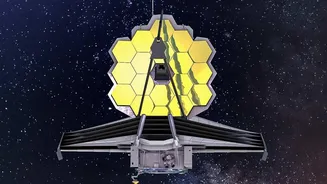
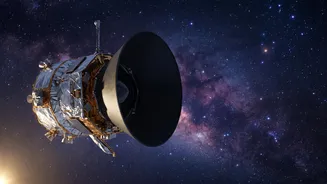
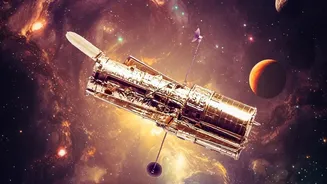
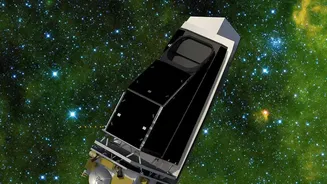
Named after Nancy Grace Roman, NASA's first chief astronomer, the telescope is a next-generation observatory with a remarkable capability. While it has a primary mirror the same size as the Hubble Space Telescope, its Wide Field Instrument can see a patch
of sky at least 100 times larger. This means that a single snapshot from Roman can contain the detail of 100 Hubble images, allowing it to survey vast regions of space with incredible speed and efficiency. Instead of zooming in on individual targets, Roman is built to create enormous cosmic maps, gathering data on billions of galaxies and stars to tackle questions about the structure and evolution of the entire universe.
Shining a Light on Dark Energy
One of Roman's primary goals is to investigate dark energy, the mysterious force believed to be responsible for the accelerating expansion of the universe. Although it makes up an estimated 68% of the cosmos, scientists still don't know what it is. Roman will tackle this enigma with its High-Latitude Wide-Area Survey, which will map the 3D positions of millions of galaxies across cosmic history. By tracking how galaxies are clustered and how their distribution has changed over billions of years, astronomers can measure the history of cosmic expansion with unprecedented precision. This will help determine if dark energy's influence has been constant or has changed over time, a key clue to its fundamental nature.
Mapping the Universe's Invisible Scaffolding
Just as mysterious as dark energy is dark matter, an invisible substance that makes up about 27% of the universe. We can't see it directly, but we know it's there because of its gravitational pull on stars and galaxies. Roman will create vast maps of dark matter's distribution by observing a phenomenon called weak gravitational lensing. As light from distant galaxies travels toward us, its path is slightly bent by the gravity of the matter it passes—both normal and dark. This subtly distort the apparent shapes of the background galaxies. By measuring these tiny distortions across millions of galaxies, Roman will trace the invisible scaffolding of dark matter, revealing how it has shaped the growth of cosmic structures over time.
A Census of New Worlds
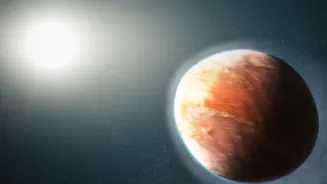
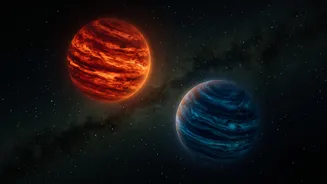
Beyond cosmology, Roman is set to be a revolutionary exoplanet hunter. Its Galactic Bulge Time Domain Survey will stare at the dense star fields in the heart of our Milky Way, searching for planets using a technique called gravitational microlensing. This method relies on the gravity of a star and its planets to act as a 'cosmic magnifying glass', bending and amplifying the light of a more distant, unrelated star that passes behind it. A brief, sharp spike in this magnified light can signal the presence of a planet. This technique is especially powerful for finding planets far from their stars, and even 'rogue' planets that drift through space without a stellar companion. In addition to finding thousands of planets through microlensing, Roman is expected to spot around 100,000 planets using the more traditional transit method, where a planet periodically dims its star's light.