





What Exactly is a Brown Dwarf?
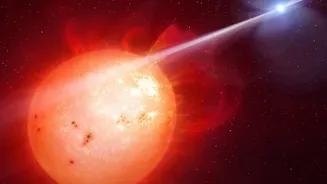
Think of a brown dwarf as a 'failed star'. Like true stars, they are born from the collapse of massive clouds of gas and dust. However, they never accumulate enough mass to kickstart the process that makes stars shine. A star, like our Sun, is defined
by its ability to fuse hydrogen into helium in its core, a process that releases immense energy. Brown dwarfs are not massive enough for this to happen. They have just enough heft to briefly fuse a heavier version of hydrogen, called deuterium, early in their lives, but they can't sustain this energy output and eventually cool and fade over time. This places them in a unique category, with masses ranging from about 13 to 80 times that of Jupiter.
The Stellar and Planetary Divide
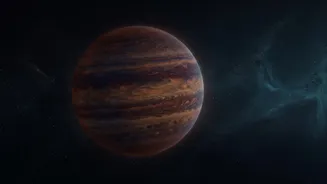
The universe seems to have clear-cut categories: stars shine, and planets orbit them. Stars are massive engines of fusion; planets are much smaller bodies formed from leftover material. Brown dwarfs complicate this neat picture. They form like stars but often have atmospheres that look more like those of giant gas planets, complete with clouds and complex molecules. Because they aren't overshadowed by the blinding glare of a parent star, many brown dwarfs offer astronomers a clearer view into atmospheric dynamics that could be similar to those on distant exoplanets. Studying their weather—which can include storms and clouds made of silicate minerals—provides a valuable, accessible laboratory for understanding planetary atmospheres elsewhere in the galaxy.
Cosmic Detectives at Work
So, how do you study an object that is often faint, cool, and difficult to spot? Scientists rely on powerful infrared telescopes, because brown dwarfs, having cooled from their formation, emit most of their faint glow as heat. The James Webb Space Telescope (JWST) has been a game-changer in this field. With its incredible sensitivity, the JWST can peer into star-forming regions and detect the faint heat signatures of these elusive objects. By analysing the light from brown dwarfs using instruments called spectrographs, scientists can determine their temperature, mass, and chemical composition, unlocking secrets about their nature and origin.
Pushing the Limits of Formation
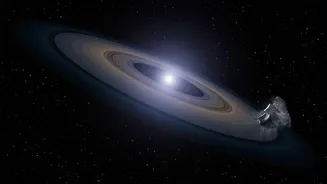
Recent observations with the JWST have pushed the boundaries of what we thought was possible. In a star-forming region called IC 348, about 1,000 light-years away, astronomers found brown dwarfs with masses as low as just two or three times that of Jupiter. This is far smaller than many theoretical models predicted, challenging our understanding of how small an object formed like a star can be. Even more astonishingly, one of these tiny, planet-mass objects showed signs of a surrounding disk of gas and dust—the very material from which planets form. This raises the tantalising possibility that a planet-sized object could be forming its own smaller planets.
Why These 'In-Between' Objects Matter
Studying brown dwarfs does more than just fill a gap in our cosmic catalogue. It directly impacts our understanding of how both stars and planets come to be. By finding the lower limit of star formation, scientists can refine their models of how gas clouds collapse to create celestial bodies of all sizes. The discovery of a unique hydrocarbon signature in the atmospheres of the smallest brown dwarfs suggests they might even represent a new, distinct class of object. These mysterious 'in-betweeners' are not failures, but rather crucial clues that help us piece together the grand, complex story of our universe and how planetary systems, including our own, are born.