





A Legacy of Firsts
Launched in 2006, New Horizons accomplished what was once a distant dream: completing the initial reconnaissance of the classical planets by visiting the Pluto system. The flyby on July 14, 2015, transformed our understanding of the dwarf planet, revealing
a complex world with towering water-ice mountains, vast nitrogen glaciers, and a potential subsurface ocean. Instead of a simple, frozen ball of rock, Pluto was shown to be geologically active and dynamic. Four years later, on New Year's Day 2019, New Horizons made history again by flying past Arrokoth, the most distant object ever explored up close. This snowman-shaped relic from the dawn of the solar system provided an unprecedented look at a planetary building block, offering clues about how planets form.
An Observatory at the Edge of the System
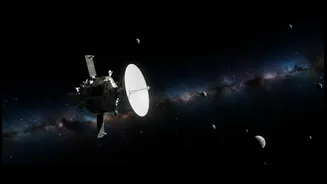
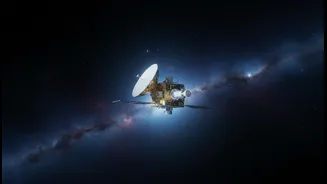
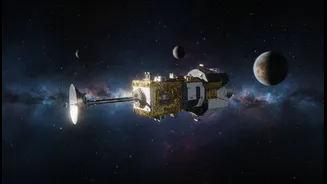
After its landmark flybys, New Horizons entered its Kuiper Belt Extended Mission. Rather than aiming for a specific destination, it has transformed into a unique deep-space observatory. From its vantage point billions of kilometres from home, it studies the environment of the Kuiper Belt, a vast, doughnut-shaped ring of icy bodies beyond Neptune. In early July 2026, the spacecraft woke up from a 321-day hibernation period, its longest yet, in perfect health. While cruising in this power-saving mode, its instruments continued to gather data on the solar wind and dust environment, providing a constant stream of information from a region no other active mission is exploring.
Unveiling Cosmic Secrets
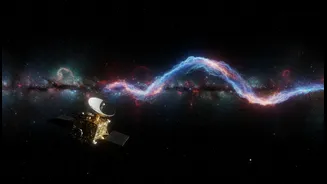
The science doesn't stop. New Horizons is currently helping to solve cosmic puzzles that can't be tackled from Earth. Its instruments are studying the faint glow of the universe, measuring the cosmic optical background, and providing data on the distribution of hydrogen at the edge of the heliosphere—the bubble of influence created by our sun. It also uses its unique position to make observations of distant planets like Uranus and Neptune that are impossible from closer to home. These observations help scientists understand the solar wind, the stream of charged particles flowing from the sun, and how it slows down as it interacts with interstellar material at the edge of our solar system.
The Long Journey Ahead
The spacecraft is currently about 9.5 billion kilometres (5.9 billion miles) from Earth, a distance so vast that its radio signals take nearly nine hours to reach us. While the mission team continues to search for a third Kuiper Belt Object for a potential flyby, finding a reachable target is a significant challenge. Even without another close encounter, the mission is far from over. Its nuclear battery is expected to provide enough power to keep its instruments running into the late 2030s or beyond. As it travels, it follows in the footsteps of the legendary Voyager probes, destined to eventually leave our solar system and venture into interstellar space.