








From Data Cruncher to Co-Scientist
The traditional role of AI in research has been as a powerful but passive tool. Scientists would conduct experiments, gather data, and then feed it to machine learning models to find patterns humans might miss. This approach has been invaluable, accelerating
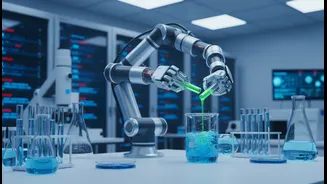
everything from genomics to material science. However, a new generation of AI, particularly large language models (LLMs), is flipping the script. These systems are moving from interpretation to creation. Instead of just analyzing the results of an experiment, they are now capable of planning and designing the experiment itself. Systems with names like 'Coscientist' are being developed to work alongside humans, taking a simple goal and generating a step-by-step procedure to achieve it. This marks a fundamental shift from AI as a tool to AI as a collaborator.
Putting AI to the Test in the Lab
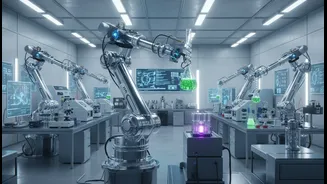
This isn't just a theoretical concept; it's already happening. Researchers at Carnegie Mellon University, for example, developed an AI system that was able to autonomously learn about Nobel Prize-winning chemical reactions. It then successfully designed a laboratory procedure to execute them. Gabe Gomes, who led the research, noted it was the first time a "non-organic intelligence" had planned, designed, and carried out such a complex reaction invented by humans. In other instances, undergraduate chemistry students have been tasked with using AI to design their own lab manuals for analyzing real-world samples, which they then followed in hands-on experiments. While the AI was effective at generating ideas, students noted it sometimes lacked detailed knowledge, highlighting the need for human oversight. At Yale, a platform called MOSAIC translates millions of published chemistry documents into actionable, step-by-step lab protocols, even for compounds that haven't been made before.
The Human Scientist's New Role
The rise of AI as an experiment designer doesn't make human scientists obsolete. Instead, it changes their job description. The new bottleneck in science isn't the generation of ideas, but the capacity to test them. An AI can propose a hundred plausible experiments overnight, but the resources—lab time, materials, and funding—are finite. The scientist's role is evolving into that of a curator, interpreter, and validator. They must use their judgment to decide which AI-generated hypotheses are worth pursuing, critically evaluate the proposed methods for safety and viability, and interpret the final results. This human-in-the-loop approach is critical. AI models can have biases from their training data, misunderstand context, or even "hallucinate" information, making human supervision essential for scientific rigor and safety.
The Promise and the Peril
The potential benefits of this new paradigm are immense. AI-powered research could dramatically accelerate the pace of scientific discovery, leading to faster development of new drugs and materials. It can democratize science, giving researchers at smaller institutions access to design capabilities previously available only to elite labs. However, significant risks accompany this power. The same AI that can design a therapeutic drug could, in the wrong hands, be used to create toxic agents or bioweapons. One study demonstrated how an AI used for drug discovery was inverted to create 40,000 toxic molecules in just six hours. Beyond malicious use, there are concerns about AI creating "monocultures of knowing," where researchers prioritize questions that AI is good at answering, potentially narrowing the scope of scientific inquiry. Ensuring data privacy, mitigating bias, and establishing accountability for AI-influenced outcomes are all urgent challenges.