





A World We Thought We Knew
For decades, Pluto was little more than a faint speck of light in even our most powerful telescopes. Scientists reasonably assumed it was a geologically dead world, a small, frigid ball of ice and rock scarred by billions of years of impacts. Lacking
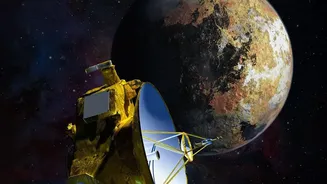
the internal heat of a large planet or the gravitational pull from a nearby gas giant, there seemed to be no energy source to drive any interesting activity. The expectation was that when NASA's New Horizons spacecraft finally arrived in 2015, it would find an ancient, unchanging surface, a perfectly preserved relic from the formation of the solar system. What it found was something far stranger and more exciting.
The Surprise of an Active Surface
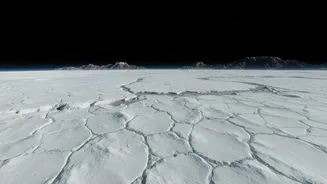
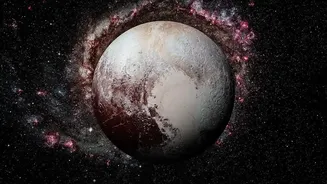
The first images from the New Horizons flyby were stunning. Instead of a uniform field of craters, they revealed vast, smooth plains, towering mountains made of water ice, and a thin, hazy blue atmosphere. The most famous feature, the heart-shaped region named Tombaugh Regio, contained a massive glacier of frozen nitrogen called Sputnik Planitia. The near-total lack of craters on this glacier was the first major clue: something was actively wiping the surface clean. This was not a dead world. This was a place with ongoing geological processes, forcing scientists to rethink how a small, cold body could remain active for billions of years.
Fire and Ice: Pluto's Cryovolcanoes
Among the most startling discoveries are features that strongly suggest the presence of cryovolcanoes, or ice volcanoes. Instead of spewing molten rock, these volcanoes erupt a slushy, icy mixture from the planet’s interior. Two massive mounds, named Wright Mons and Piccard Mons, have been identified as prime candidates. These structures are enormous, with one rivaling the size of Hawaii's Mauna Loa. Scientists believe they were formed over multiple episodes, spewing vast amounts of icy material that resurfaced the entire region. The a lack of craters on and around them suggests this activity is geologically recent, happening within the last few hundred million years—a blink of an eye in cosmic terms.
What Powers the Icy Heart?
The great mystery is where Pluto gets the energy for all this activity. It's too far from the Sun for solar heating to be a factor. One leading theory is that Pluto retains heat from its formation, insulated by a subsurface ocean of liquid water. The decay of radioactive elements within its rocky core could provide another steady source of warmth. This internal heat could be enough to keep an underground ocean from freezing completely and power the churning of nitrogen glaciers on the surface. More recent studies even suggest that liquid nitrogen may seep up from below the ice, creating dark streaks on the surface as it flows and refreezes, a process likened to a 'bleeding' heart.
More Than Just a Dwarf Planet
The revelations from New Horizons have transformed our understanding of Pluto. We now see it as a complex, layered world with flowing nitrogen glaciers, mountains of rock-hard water ice, and a dynamic atmosphere with haze. Scientists have identified vast fault systems and canyons, suggesting past tectonic activity, possibly linked to the expansion of a freezing subsurface ocean. These discoveries prove that even small, remote worlds can have surprisingly complex and active histories. Pluto is no longer a simple footnote at the edge of the solar system; it is a geological wonderland that continues to surprise scientists more than a decade after the first and only close-up look we've ever had.