



A Cosmic Ghost in Our Galaxy
First, let's address the name. The 'Gaia Sausage' isn't a celestial deli item, but the evocative name given to the remnants of a dwarf galaxy that merged with our own. The name, also known as Gaia-Enceladus, came about when astronomers, using data from
the European Space Agency's Gaia mission, plotted the velocities of stars left over from this ancient merger. In that chart, the distribution of these stars' elongated, radial orbits looked remarkably like a sausage. These 'sausage stars' are the fossil record of a galaxy that was devoured by a young Milky Way between 8 and 11 billion years ago. It was a substantial galaxy, possessing a mass more than 10 billion times that of our sun, making its collision one of the most significant events in our galaxy's history.
When Worlds Collided
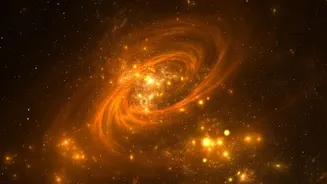
The merger was less a gentle merging of streams and more of a cosmic car crash. Around 10 billion years ago, long before our solar system existed, the Gaia Sausage galaxy collided head-on with the Milky Way. At the time, our own galaxy was much smaller, making the impact from this relatively massive dwarf galaxy a truly formative event. The collision was chaotic. The immense gravitational forces of the larger Milky Way tore the Gaia Sausage apart, scattering its stars and globular clusters throughout what would become the Milky Way's 'stellar halo'—a sparse, spherical cloud of stars enveloping the main galactic disc. This event didn't just add material to our galaxy; it triggered a massive burst of star formation, a galactic 'firework' that helped build up the Milky Way we see today.
How to Tilt a Galaxy
The most dramatic consequence of this collision is a relatively new and startling theory. According to supercomputer simulations run by astronomers at Durham University, the sheer force of the head-on impact may have caused the entire disc of the Milky Way to flip by more than 90 degrees. This galactic reorientation would have been a slow, ponderous process, taking hundreds of millions of years. Think of it like a spinning top being struck; the impact doesn't just knock it over, it can cause it to tilt and wobble on a new axis. The research suggests this is what happened to our galaxy. This 'disc flip' theory helps explain a long-standing mystery: why the stars in the Milky Way's halo rotate so slowly compared to the stars in its disc. The simulations showed that galaxies with slowly rotating halos were far more likely to have experienced both a major head-on collision and a subsequent disc flip.
Reading the Galactic Fossil Record
This incredible story is pieced together from stellar data of unprecedented precision, largely thanks to the Gaia space telescope. Gaia has been meticulously mapping the positions, movements, and chemical compositions of billions of stars. By studying the stars from the Gaia Sausage, astronomers can identify them by their unusual, highly elongated orbits and distinct chemical makeup. The evidence for the collision is written in these stellar paths. For example, many 'sausage stars' travel deep into the galaxy and then all 'turn around' at roughly the same distance from the galactic center, creating a pile-up in their orbits. This observational data, when fed into powerful computer models that simulate galaxy formation over billions of years, allows scientists to test different collision scenarios and see which ones produce a Milky Way that looks like ours today. The results strongly point to a dramatic flip in our past.