



The Sun: A Threat to Our Digital World
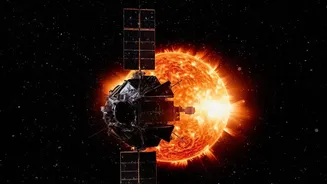
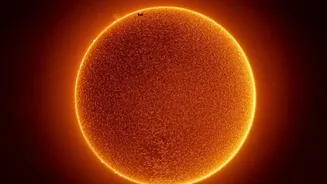
We think of the Sun as a source of life and warmth, but it also has a violent side. It constantly ejects a stream of charged particles called the solar wind. Sometimes, it erupts with more powerful blasts, like solar flares and coronal mass ejections
(CMEs). When these eruptions are aimed at Earth, they can wreak havoc. These events create what is known as space weather. While Earth's magnetic field protects us from most of it, a powerful storm can overwhelm our defences, inducing destructive electrical currents on the ground. These currents can damage high-voltage transformers, leading to widespread power blackouts like the one that struck Quebec in 1989. They can also disrupt satellite operations, interfere with GPS signals, and black out high-frequency radio used by airlines. In an increasingly digital India, from UPI payments to satellite-based services, our vulnerability to space weather is greater than ever.
IMAP: Our New Watchtower in Space
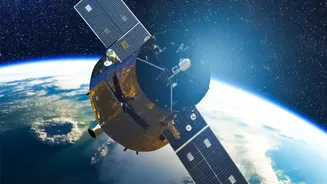
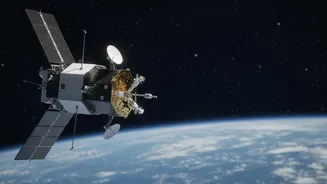
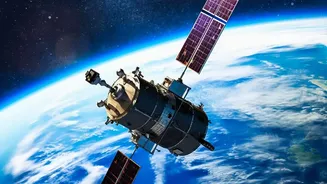
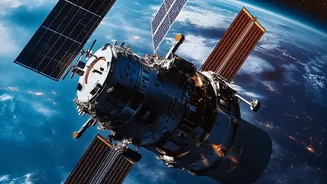
Enter the Interstellar Mapping and Acceleration Probe, or IMAP. Launched by NASA in September 2025, IMAP is a state-of-the-art observatory with a crucial job. While its primary mission is to study the boundary of our solar system, a key part of its function is to serve as an advanced space weather sentinel. In January 2026, the spacecraft reached its destination: a gravitationally stable spot in space called Lagrange Point 1 (L1), located about 1.5 million kilometres from Earth in the direction of the Sun. This unique vantage point allows IMAP to get a constant, unobstructed view of the solar wind and any dangerous solar eruptions long before they reach our planet. Think of it as a celestial watchtower, giving us a vital head-start to prepare for an incoming storm.
The 'Near-Real-Time' Advantage
Previous missions have studied the solar wind, but IMAP's game-changing feature is its speed. The mission includes a system called the IMAP Active Link for Real-Time (I-ALiRT). This system uses a portion of the data from five of IMAP's ten science instruments to continuously broadcast a stream of critical information back to Earth. This isn't data that gets stored and downloaded weeks later; it’s a 24/7, low-latency feed designed for immediate action. Because IMAP is positioned directly between the Sun and Earth, the solar wind it measures is the same wind that will hit our planet roughly 30 to 60 minutes later. That half-hour warning is a precious window of time for grid operators, satellite companies, and airlines to take protective measures.
From Raw Data to Actionable Alerts
IMAP's I-ALiRT doesn't just tell us the wind is coming; it provides rich detail about its characteristics. Instruments like the Solar Wind Electron (SWE) and Solar Wind and Pickup Ions (SWAPI) measure the density, speed, temperature, and magnetic orientation of the incoming particles. This is crucial because the magnetic orientation of a CME determines how severely it will interact with Earth's magnetic field. This real-time data, which became publicly available in 2026, is fed directly to space weather forecasters, such as those at the US National Oceanic and Atmospheric Administration (NOAA). They can then issue more accurate and timely warnings, allowing power companies to brace their systems, satellite operators to put their craft into a safe mode, and airlines to reroute flights away from polar regions where radiation exposure is higher.
What IMAP Means for India
The benefits of improved space weather forecasting are global, and they are particularly relevant to a rapidly growing economy like India's. Our nation's Digital India initiative, increasing reliance on GPS for logistics and transportation, and our ambitious space program with ISRO all depend on robust infrastructure that is vulnerable to solar activity. Better warnings from IMAP help protect these multi-billion dollar investments. It allows Indian grid operators to be better prepared for potential surges and helps ensure the stability of communication networks that are the backbone of our economy. As India expands its own satellite constellations and human spaceflight ambitions, having a reliable international early-warning system like the one provided by IMAP becomes a matter of national strategic importance, safeguarding both our assets and our future in space.