

The Solar System’s Oddball
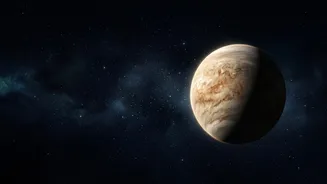
In the family of planets, Venus is the strange one. While similar to Earth in size and mass, its behaviour is bizarre. It spins backward compared to most other planets, and its day is longer than its year. A single rotation on Venus takes a staggering
243 Earth days. Scientists have long puzzled over these peculiarities, proposing everything from giant ancient impacts to complex atmospheric forces as the cause. This profound weirdness is why the mystery of its missing moon is so compelling. Most rocky planets either have a moon or are too small to hold one. For a planet of Venus's stature to be alone is an anomaly that demands an explanation.
A Ghost in the Machine
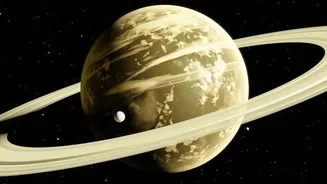
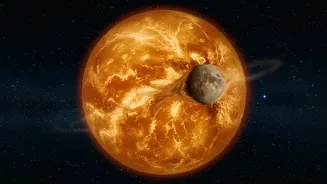
For years, the leading theories for the moonless Venus were that it either never had a moon-forming collision like Earth did, or that a later, catastrophic impact shattered its satellite. But a new study published in The Astrophysical Journal offers a more intimate, and somehow more tragic, possibility. A team led by astrophysicist Stephen Kane of the University of California, Riverside, suggests that Venus didn't need an external catastrophe to lose its companion. Using computer simulations, they showed that the planet’s own physics could have doomed any moon it once had. The very same forces that govern our own Moon’s orbit may have worked in reverse on Venus, pulling its satellite into a fatal embrace.
The Cosmic Tug-of-War
The relationship between a planet and its moon is a delicate dance of gravity and momentum known as tidal interaction. Here on Earth, our planet spins much faster than the Moon orbits. This rapid rotation transfers energy to the Moon, causing it to drift away from us by about four centimetres every year. Kane's simulations showed what happens when you flip the script. Venus rotates incredibly slowly. This sluggish spin would have the opposite effect. Instead of pushing a moon away, the planet's tidal forces would pull it inward. This gravitational tug-of-war is a battle the moon would inevitably lose. Over millions of years, its orbit would decay, spiraling closer and closer to the planet until it reached a point of no return.
Death by a Thousand Kilometres
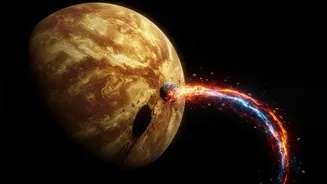
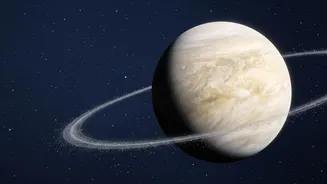
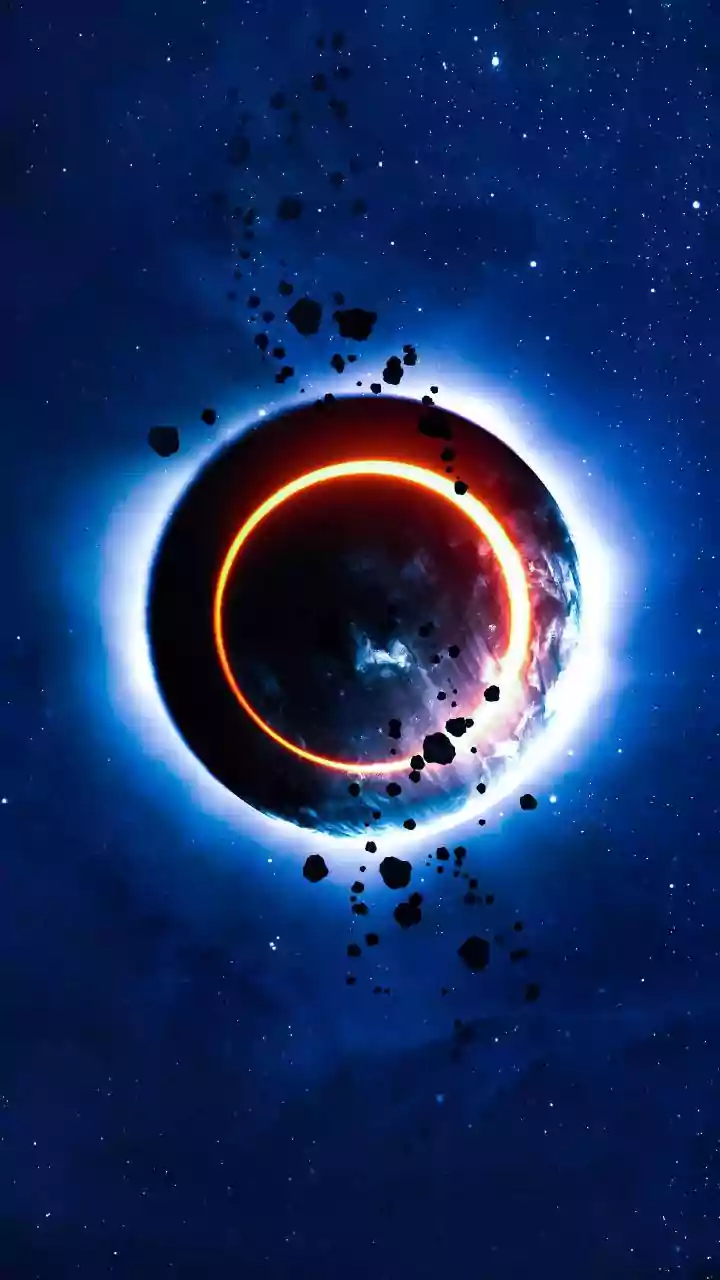
The final moments would have been apocalyptic. As the hypothetical moon spiraled inward, it would have eventually crossed the 'Roche limit'—the point at which the planet's gravitational pull becomes stronger than the moon's own gravity holding it together. At this distance, Venus would have literally torn its moon apart, creating a temporary ring of debris. This material would then rain down onto the planet. The simulations showed this process was almost unavoidable for a wide range of moon sizes, with larger moons potentially crashing into the planet even faster. Such a massive collision would have unleashed an incredible amount of energy, which could have dramatically altered the planet’s climate, kick-started its runaway greenhouse effect, and helped forge the hellish landscape we see today.
An Unsolved Mystery
While the simulations are compelling, it's important to remember this remains a theory. The study does not prove Venus ever had a moon, only that it would have struggled to keep one if it did. Finding direct evidence of this ancient collision is incredibly difficult. A massive volcanic resurfacing event about a billion years ago is thought to have paved over most of the planet's ancient crust, erasing any impact craters or debris fields. Future clues may lie hidden deep inside the planet or as subtle chemical signatures in the thick atmosphere. Missions like NASA's planned DAVINCI probe, which will descend through the Venusian clouds, could one day help us find the ghost of a lost world.