





The Star's 'Iron Problem'
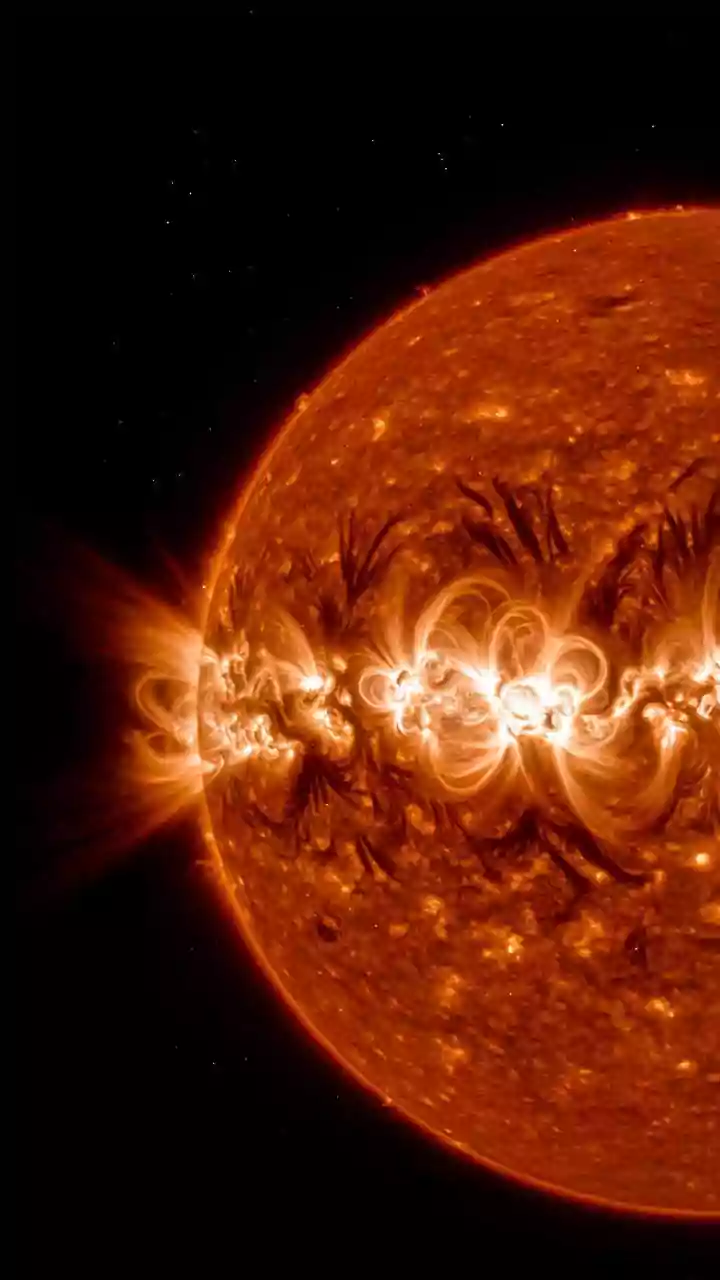
For most of their lives, stars are engaged in a delicate balancing act. The immense crush of their own gravity is held at bay by the outward pressure from nuclear fusion in their cores. Stars fuse lighter elements into heavier ones, starting with hydrogen
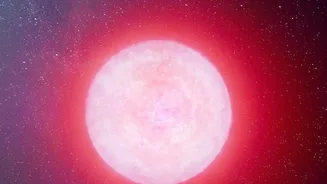
and moving up the periodic table. Hydrogen becomes helium, helium becomes carbon, and so on. Each step releases a tremendous amount of energy. This process, however, hits a hard wall at iron. Fusing elements lighter than iron produces energy, but fusing iron into something heavier actually consumes energy instead of releasing it. For a star, which needs that energy to fight off gravitational collapse, creating iron is a dead end. The core goes cold, the outward pressure stops, and the star’s life as an element factory is over.
A Different Kind of Alchemy
If fusion stops at iron, how does the universe create heavier treasures like gold, platinum, and uranium? It requires a completely different mechanism, one that doesn't rely on the energy-producing fusion of a star's core. The solution is a process called rapid neutron capture, or the 'r-process'. Instead of fusing atomic nuclei together with heat and pressure, the r-process involves bombarding existing atomic nuclei with a massive flood of neutrons. Because neutrons have no electric charge, they can slip into a nucleus without being repelled. In an environment with an incredibly high density of neutrons, a nucleus can absorb many of them in a fraction of a second, becoming heavy and unstable before it has a chance to decay. It then undergoes radioactive decay, with neutrons transforming into protons, to become a new, stable, and much heavier element.
The Ultimate Cosmic Forge
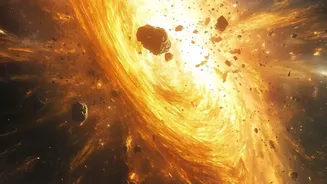
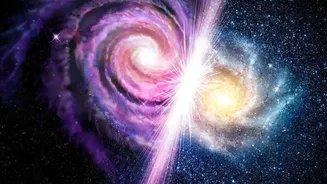
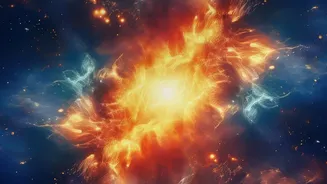
So, where in the universe can you find an environment extreme enough for the r-process to occur? For a long time, scientists suspected supernovae were responsible, but while they do contribute, they couldn't account for all the heavy elements we see. The primary answer, confirmed in recent years, is even more spectacular: the collision of two neutron stars. Neutron stars are the ultra-dense remnants of massive stars that have already gone supernova. They pack more mass than our sun into a sphere just a few kilometres across. When two of these objects, locked in a binary system, finally spiral into each other, the collision is cataclysmic. This event, known as a kilonova, unleashes a torrent of energy and, crucially, ejects vast quantities of neutron-rich matter into space. This creates the perfect, chaotic 'pressure cooker' for the r-process to run wild.
From Collision to Cosmic Treasure
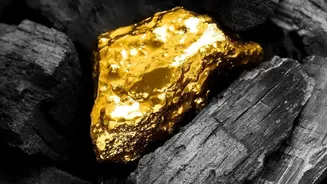
In the seconds following a neutron star merger, the ejected material becomes the universe’s most productive alchemy lab. Trillions upon trillions of neutrons slam into seed nuclei, rapidly building up the heaviest elements on the periodic table. It is in these brief, violent moments that the universe forges its most precious metals. A single neutron star collision can produce enormous quantities of these materials; one event detected in 2017 is estimated to have created at least ten Earth masses worth of gold and platinum alone. Elements like strontium, tellurium, and uranium are also synthesised in these cosmic fireworks. This material is then blasted out into the cosmos, enriching the interstellar clouds of gas and dust from which new stars and planetary systems will eventually form.
The Golden Evidence
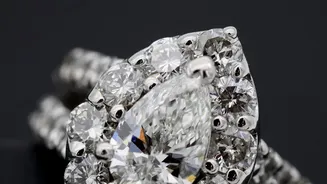
This isn't just a well-argued theory; scientists have seen it happen. The breakthrough came on August 17, 2017, when the LIGO and Virgo gravitational wave detectors picked up ripples in spacetime from two neutron stars colliding about 130 million light-years away. Telescopes across the globe quickly turned to the source and observed the resulting kilonova explosion. As they analysed the light from this fading fireball, they found the distinct chemical fingerprints of heavy elements like strontium and even hints of gold and platinum. It was the first direct observation of the r-process in action, confirming that these cosmic smash-ups are a primary source for the heaviest elements. The gold in your jewellery was very likely forged in a violent collision of neutron stars billions of years ago.