







A New Lease on Life
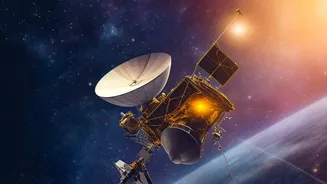
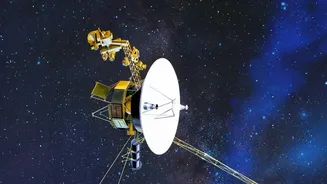
NASA has successfully extended the scientific life of its Voyager 2 spacecraft, which is currently journeying through the space between stars. In an operation nicknamed the “Big Bang,” engineers remotely reconfigured the probe’s power systems. This move
has secured at least one additional year for its science instruments to continue operating. Without this intervention, the dwindling power supply would have forced the mission team to shut down another one of its valuable instruments before the end of 2026.
The Challenge of Deep Space
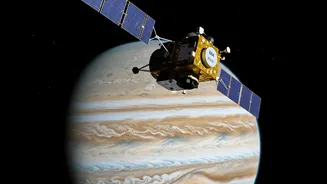
Launched in 1977, Voyager 2 and its twin, Voyager 1, were designed for a five-year mission to study Jupiter and Saturn. Nearly half a century later, they are the most distant human-made objects, having long since left the protective bubble of the Sun’s influence, known as the heliosphere. Their longevity is a marvel, but it comes with a significant challenge: a constantly diminishing power supply. The probes are powered by radioisotope thermoelectric generators, which convert heat from decaying plutonium into electricity. Every year, the available power drops by about 4 watts, forcing engineers into a careful balancing act of resource management.
The ‘Big Bang’ Fix
The solution was a masterclass in remote engineering. Communicating with a spacecraft over 21 billion kilometres away is no simple task; each command takes nearly 20 hours to arrive. The team identified power-hungry systems, like specific heaters, that could be turned off. They then found clever ways to use lower-power alternatives to provide the residual heat needed to keep the spacecraft's systems warm enough to function in the freezing temperatures of interstellar space. This intricate power-shuffling act successfully reduced the probe’s energy consumption without compromising its ability to collect data.
Why This Data Is Irreplaceable
The data Voyager 2 is collecting is truly unique. It is the only operational spacecraft, along with its twin, to directly sample the interstellar medium. Its three remaining active instruments—a magnetometer, a plasma wave subsystem, and a cosmic ray subsystem—are our only direct eyes and ears in this unexplored territory. They measure the particles, magnetic fields, and plasma waves that exist outside our solar system, providing invaluable ground truth that helps scientists understand the environment our Sun travels through. Every extra day of data adds to a priceless repository of knowledge that cannot be obtained from Earth.
The Business of Exploration
From a strategic perspective, this extension represents an incredible return on investment. The original mission was completed decades ago, yet the spacecraft continues to deliver groundbreaking science. Managing a dwindling power budget for a nearly 50-year-old asset billions of kilometres away is the ultimate exercise in operational efficiency. The success of the “Big Bang” fix on Voyager 2 provides a blueprint for a similar procedure planned for Voyager 1 in the coming months. This clever management ensures that humanity's farthest ambassadors can continue their vital work for as long as their fading power supplies will allow, potentially sending back data well into the 2030s.