







The Sun’s Puzzling Brightness Paradox
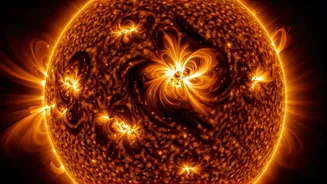
It sounds counterintuitive, but the Sun is actually at its brightest when it's covered in the most dark spots. This period, known as the solar maximum, occurs roughly every 11 years. Sunspots themselves are cooler, darker patches on the solar surface
caused by intense magnetic fields. But these sunspots are accompanied by intensely bright regions called faculae. For years, scientists have believed that the extra brightness from faculae more than compensates for the dimming from sunspots, making the Sun about 0.1% brighter overall during solar maximum. However, models based on this understanding have never perfectly matched the real-world observations of the Sun's total energy output. This discrepancy, a persistent thorn in the side of solar physics, suggests something is missing from our understanding of how these features balance out.
Enter a Planet-Hunting Telescope
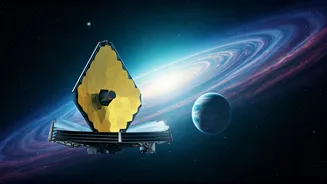
The key to this solar mystery came from an unexpected source: NASA’s Kepler space telescope. Launched in 2009, Kepler’s primary mission was to find exoplanets, or planets orbiting other stars. It did this by staring at a patch of over 150,000 stars, looking for tiny, periodic dips in their brightness caused by a planet passing in front of them—an event called a transit. To find these subtle dips, Kepler had to measure stellar brightness with unprecedented precision and consistency over many years. While its goal was to find planets, the mission inadvertently created a massive and invaluable database on the behaviour of stars themselves, including their own versions of sunspots, known as starspots.
Learning from a Thousand Suns
A team of researchers realised this stellar database could be used to look at our own Sun in a new context. Instead of relying only on observations of our single star, they could study the relationship between spots and brightness across hundreds of Sun-like stars observed by Kepler. By treating the Sun as just one star among many, they could test if its behaviour was typical. Their analysis of this vast dataset led to a groundbreaking hypothesis. They found that the relationship between the dimming from starspots and the brightening from their active regions might be different than what has been assumed from observing our Sun alone. The data from other stars suggested that the dimming effect of spots could be stronger than our models accounted for.
A New Answer to an Old Question
This new perspective suggests that our models of the Sun’s brightness may be flawed because they are based on a sample size of one. By incorporating the broader context provided by the Kepler data, scientists can refine their models. The new hypothesis is that our understanding of the magnetic fields within sunspots and their impact on brightness was incomplete. The collective data from many stars implies that the dimming effect of sunspots is more significant than previously thought, which could resolve the long-standing discrepancy between models and actual measurements of the Sun's energy output. It doesn't rewrite the laws of physics, but it fine-tunes our application of them to our home star, providing a more accurate picture of its intricate behaviour.