




Not Your Average Dust
Moon dust, or regolith, is nothing like the dust on Earth. Billions of years of micrometeoroid impacts, without wind or water to smooth them down, have created a layer of fine, sharp, and abrasive particles. This material is like tiny shards of glass.
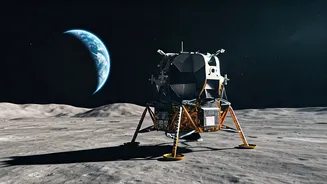
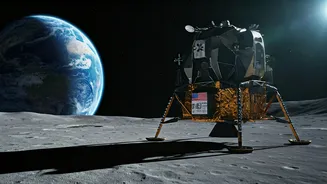
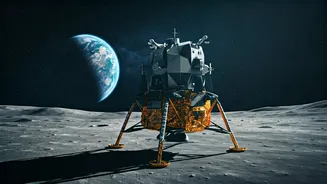
During the Apollo missions, this jagged dust caused significant problems. It eroded space suits, damaged seals, and when carried into the lunar module, caused respiratory and eye irritation for astronauts. Apollo 17’s Gene Cernan called dust “one of the greatest inhibitors to a nominal operation on the Moon,” noting its restrictive, friction-like action on everything it touched. Because it is electrostatically charged, it clings to everything, making it incredibly difficult to remove.
A High-Speed Threat
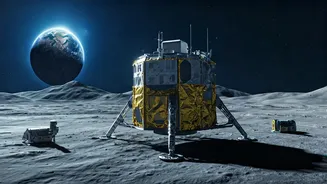
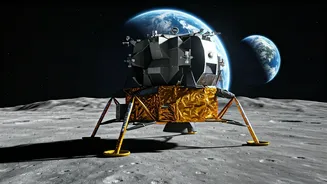
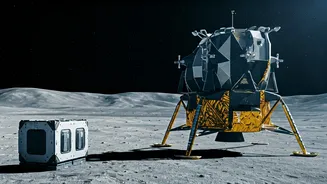
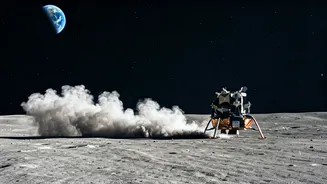
When a lander's powerful rocket engine fires near the surface, it creates a plume that interacts with the regolith in the Moon's low-gravity, vacuum environment. This interaction, known as plume-surface interaction (PSI), doesn't just kick up a bit of dust; it creates a high-velocity spray of abrasive particles traveling at speeds up to kilometers per second. This sandblasting effect can create craters, destabilize the landing area, and pose a severe threat to the lander itself and any nearby hardware, such as other spacecraft, scientific instruments, or future habitats. The ejected dust can even travel far enough to enter lunar orbit, creating a hazard for orbiting assets.
The Artemis Era Magnifies the Problem
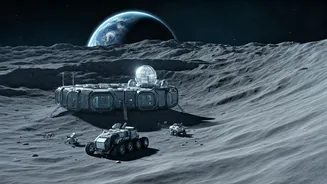
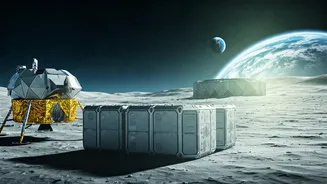
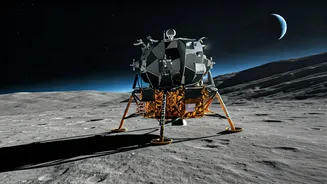
The challenge of lunar dust is more critical than ever with the Artemis program, which aims to establish a sustained human presence on the Moon. Unlike the relatively small Apollo lunar modules, the new generation of human landing systems, like SpaceX's Starship, are much larger and heavier. Their more powerful engines will displace significantly more regolith, potentially four to ten times more than previous estimates suggested. This makes understanding and mitigating plume effects essential for the safety of astronauts and the long-term viability of a lunar base. Repeated landings at the same outpost could degrade the entire area, sandblasting critical infrastructure like solar panels, optics, and habitats with each arrival and departure.
Searching for Solutions on Earth
To tackle this, NASA is conducting extensive research. At its Marshall Space Flight Center, engineers have test-fired powerful hybrid rocket motors to simulate the exhaust of future landers. These tests, often conducted in vacuum chambers to mimic lunar conditions, provide crucial data for computer models. At NASA's Langley Research Center, teams are firing these rocket plumes into simulated lunar soil to measure the size of the craters formed and the velocity of the ejected particles. Other research includes suborbital rocket flights carrying experiments to study dust behavior in simulated lunar gravity. Instruments like the Stereo Cameras for Lunar Plume-Surface Studies (SCALPSS) are also being developed to be placed on commercial landers to capture real-time data from an actual lunar landing.
Paving the Way for a Safer Return
The research is pointing toward several innovative solutions. One of the most promising is the construction of landing pads. NASA and its commercial partners are exploring ways to build these pads using in-situ resources, such as melting or sintering the lunar regolith itself into a durable, solid surface. Companies like ICON are designing 3D-printed landing pads with advanced features like blast walls and dust trenches to manage exhaust. Another concept involves a lander creating its own pad as it descends by spraying a ceramic-like material into its own exhaust plume. In parallel, NASA is developing Electrodynamic Dust Shield (EDS) technology, which uses electric fields to actively repel dust from critical surfaces like solar panels, camera lenses, and spacesuits, providing a crucial first line of defense.