


More Than a Momentary Flash
When you wish upon a star, you are likely looking at a meteor—a tiny speck of cosmic dust, often no bigger than a grain of sand, burning up as it enters Earth's atmosphere at incredible speed. For most of us, this spectacle is a quick, silent, white line.
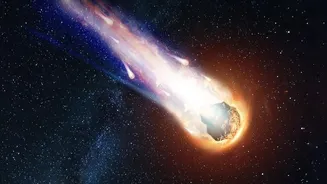
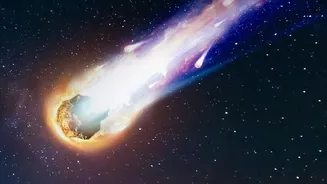
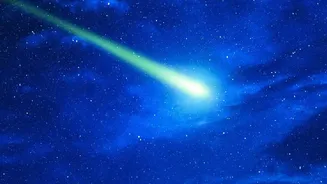
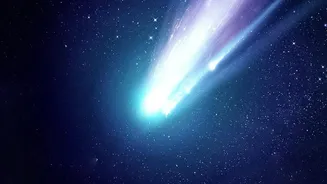
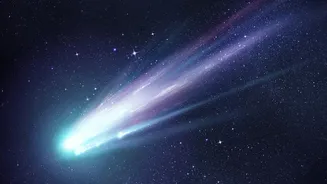
However, a recent high-resolution capture, celebrated by NASA, paints a much more intricate and colourful picture. Instead of a simple streak, the image reveals a vibrant, multi-hued trail, a detailed story of a violent demise. It shows a brilliant green glow, bursts of yellow and orange, and even a faint violet tinge, challenging our simple perception of these celestial visitors.
The Science of a 'Simple' Streak
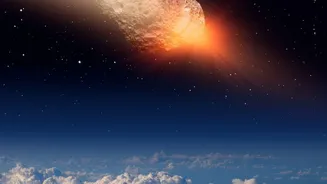
What we call a 'shooting star' is not a star at all. It is the result of a meteoroid hitting our atmosphere at speeds of up to 72 kilometres per second. The intense friction generated by this entry compresses and heats the air in front of the particle, creating a pocket of super-heated plasma. This extreme heat vaporises the meteoroid in a process called ablation. The resulting streak of light, the meteor, is the glow from this incredibly hot, ionised trail of gas and vaporised particles. For the naked eye, faint meteors often appear white or yellow simply because the light is not bright enough to stimulate our eye's colour-sensing cones. Most of the light is simply the glow of the hot object and super-heated nitrogen and oxygen in the atmosphere.
A Chemical Fingerprint in the Sky
The spectacular colours seen in NASA's image are a form of celestial chemistry. They act as a fingerprint, revealing the meteoroid’s composition. Just like a flame test in a chemistry lab, different elements burn with distinct colours when vaporised at high temperatures. A green hue, like the one prominent in the August 3rd image, is typically caused by vaporised nickel or magnesium. Flashes of orange or yellow point to the presence of sodium, while iron often glows yellow. Rarer shades, like violet or purple, can indicate calcium. The speed of the meteor also plays a role; faster meteors can cause the very air molecules around them to glow, with super-heated nitrogen and oxygen sometimes adding a reddish tint. This cosmic light show is therefore a detailed inventory of the object's makeup.
A Story of a Violent End
Beyond colour, the image also reveals information about the meteor's final moments. It is not a uniform line but shows fluctuations in brightness and even appears to fragment. Many meteoroids are not solid, dense rocks but are more like loosely packed dust-balls, especially those originating from comets. As they hit the atmosphere, the immense pressure can cause them to break apart in a process called fragmentation. These fragmentation events can cause sudden flares in brightness along the meteor's path, as more surface area is suddenly exposed to atmospheric friction. By studying the light curve—the pattern of brightness from start to finish—scientists can learn about the meteoroid's density and structure, determining if it was a solid piece of an asteroid or a fragile fragment from a comet.
Why This Matters for Science
An image like this is more than just a pretty picture; it is valuable scientific data. NASA operates networks of cameras, such as the All Sky Fireball Network, to systematically capture and study these events. By analysing a meteor's light and trajectory, scientists can trace its origin back to a specific parent body, like Comet Swift-Tuttle for the Perseids, or an asteroid. This helps them map the streams of debris our planet passes through. Furthermore, these burning particles are natural probes of our upper atmosphere. Studying how they burn up provides information about the density, composition, and wind patterns in layers of the atmosphere that are otherwise difficult to study. The dust and smoke left behind, composed of elements like iron and magnesium, can even influence atmospheric processes.