




A Celestial Lion's Roar
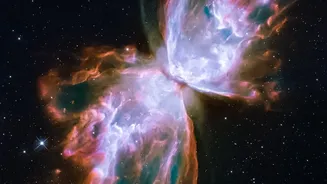
Known to astronomers as NGC 2392, the Lion Nebula gets its nickname from its uncanny resemblance to a lion's head, complete with a flowing mane. At its heart, a bright point of light that looks like a button nose is all that remains of a once-mighty star.
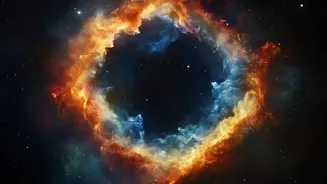
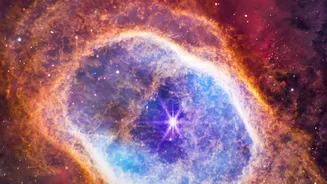
This celestial portrait is a planetary nebula, a vast cloud of gas and dust cast off by a dying star similar to our own Sun. The image, a composite of near- and mid-infrared light, showcases the intricate structures carved out by intense radiation from the star's hot, collapsed core. The inner region, forming the lion's 'face,' is a bubble of superheated gas, while the outer 'mane' is a cooler ring of dust and gas featuring comet-like tails.
Anatomy of a Star's End
Most stars in the universe, including our Sun, are not massive enough to explode in a violent supernova. Instead, they face a more gradual, albeit equally dramatic, end. When a Sun-like star exhausts the hydrogen fuel in its core, it swells into a red giant. Eventually, it can no longer sustain nuclear fusion at its center and becomes unstable, shedding its outer layers into space. These expelled layers form the beautiful, expanding shells of a planetary nebula. Left behind is the star's incredibly hot and dense core, known as a white dwarf. This stellar remnant, though small, is intensely powerful, blasting out radiation that ionizes the surrounding gas, causing it to glow.
What Webb's Vision Reveals
While the Hubble Space Telescope first gave us a clear look at the Lion Nebula in 2000, the James Webb Space Telescope's powerful infrared instruments cut through the cosmic dust to reveal hidden secrets. Webb's view distinguishes between the hot, ionized gas of the inner bubble and the cooler, clumpy dust filaments of the outer mane. These detailed observations help astronomers understand how the outflow from the dying star interacts with the material around it, creating the complex rings and shells common to planetary nebulae. The image shows dense clumps of dust that have so far survived the onslaught of radiation from the central white dwarf, protecting the material trailing behind them and forming the mane's distinct, wispy tendrils.
A Glimpse of Our Solar System's Future
Observing the Lion Nebula isn't just about admiring a distant cosmic object; it's like looking into a crystal ball for our own solar system. In about five billion years, our Sun will run out of fuel and begin its own final transformation. It will swell into a red giant, likely engulfing the inner planets, before puffing away its outer atmosphere to form its own planetary nebula. A white dwarf will be all that remains of the star that has nurtured life on Earth for eons. By studying objects like NGC 2392, scientists can piece together the story of our Sun's eventual fate and the life cycle of stars across the galaxy. The Lion Nebula is a snapshot in time, a temporary monument to a star's life that will itself disperse into space over the next 10,000 years or so, a fleeting moment in cosmic terms.