






The Promise of a Shorthand Solution
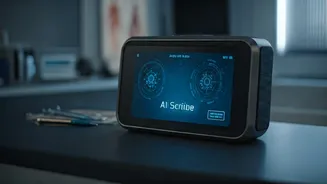
Doctors are burning out from administrative overload, with studies showing they spend hours each day on documentation. AI medical scribes offer a solution. These tools use ambient voice technology to listen to and transcribe conversations between a doctor
and patient in real-time. Using artificial intelligence and natural language processing, the software then automatically structures this conversation into a coherent clinical note, ready for the electronic health record (EHR). The goal is to reduce the documentation burden, which can take up to 70-90% less time with these tools, allowing physicians to focus more on the patient in front of them rather than a computer screen.
Where Does Your Private Data Go?
The convenience of AI scribes comes with a significant trade-off: privacy risks. When an AI scribe records a consultation, it captures some of the most sensitive information imaginable, including diagnoses, medical history, and personal details. The fundamental question becomes: what happens to this data? Concerns abound regarding where these recordings and transcripts are stored, who has access to them, and for how long. Some systems retain recordings for a period, like 30 days, before deletion, but this still creates a window of vulnerability. A recent incident in Ontario highlighted the risk when an AI scribe, linked to a former physician's calendar, joined and recorded a virtual meeting without authorisation, exposing the health information of seven patients.
The Critical Issue of Consent
A key ethical and legal hurdle is patient consent. Before any recording begins, patients must be clearly informed and agree to the use of an AI scribe. Privacy commissioners and medical associations have warned that simply implying consent is not enough; it should be explicit, often in writing. Patients need to understand what they are agreeing to, including the fact that their anonymised data might be used to train the AI model further. This raises questions about whether patients truly comprehend the risks and have a meaningful way to opt out without affecting their care.
Accuracy and Accountability
Beyond privacy, there are serious concerns about the accuracy of AI-generated notes. These systems can misinterpret words, miss clinical nuance, or even 'hallucinate' and add details that were never discussed. While the technology is impressive, it is not flawless, and accents or background noise can lead to errors. Ultimately, the legal and ethical responsibility for the accuracy of a medical record rests with the human clinician who signs off on the note. Over-reliance on these tools without careful review could lead to serious medical errors, shifting a partial burden onto patients to double-check their own records for mistakes.
Navigating a New Regulatory Landscape
Technology is advancing faster than regulation. In India, the Digital Personal Data Protection (DPDP) Act of 2023 establishes a comprehensive framework for handling all personal data, including highly sensitive health information. The act grants patients significant rights, such as the right to be informed, to give specific consent, and to have their data corrected or deleted. For any organisation using AI scribes, this means implementing robust security measures, ensuring transparency, and obtaining clear, revocable consent. Companies providing these tools must also adhere to strict standards, often through a Business Associate Agreement (BAA), to ensure they protect patient information with measures like end-to-end encryption and access controls.