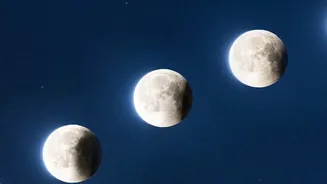




Ever wonder why the Moon looks different every night? It’s not changing shape, but our view of it is. The Moon doesn’t make its own light; it's just reflecting the Sun. The phases we see are all about our changing perspective from Earth.
The Moon's Constant Dance
The Moon is in
a constant orbit around the Earth, completing a full circle roughly every 29.5 days. Like Earth, the Moon always has one half lit by the Sun (its 'day' side) and one half in darkness (its 'night' side). The phases we see depend entirely on how much of that sunlit half is facing us as the Moon travels on its orbital path. It’s a beautiful cosmic dance between the Sun, Earth, and Moon, and our view from the audience changes nightly.
From New Moon to Full
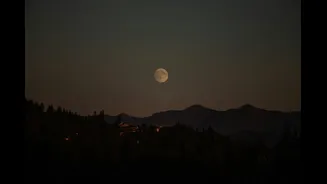
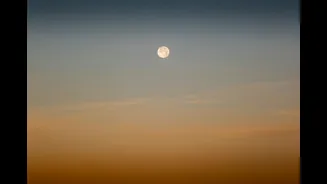
The cycle begins with the New Moon. Here, the Moon is between the Earth and the Sun, so the side facing us is not illuminated. It’s essentially invisible in our sky. A few days later, we see a sliver of light, the Waxing Crescent. 'Waxing' means the light is growing. Next comes the First Quarter, where we see exactly half the Moon lit up. This is followed by the Waxing Gibbous, where it’s more than half lit but not yet full. The peak of the cycle is the Full Moon, when the Earth is between the Sun and Moon, allowing us to see its entire sunlit face.
From Full Moon Back to New
After the brilliance of the Full Moon, the process reverses. The light begins to shrink, which we call 'waning'. First is the Waning Gibbous, when the light starts to recede from a full circle. This is followed by the Third Quarter (or Last Quarter), where we again see a half-lit Moon, but it's the opposite half from the First Quarter. As it nears the end of its cycle, it becomes a Waning Crescent, just a sliver of light visible before dawn. Finally, the Moon disappears from our sight once more as it enters the New Moon phase, ready to begin the cycle all over again.
A Common Misconception: The Earth's Shadow
Many people mistakenly believe the phases are caused by the Earth's shadow falling on the Moon. While that does happen, it's a much rarer event called a lunar eclipse. During a lunar eclipse, the Earth passes directly between the Sun and a Full Moon, casting its shadow over the lunar surface. The regular monthly phases, however, are purely a matter of our viewing angle. If the Earth’s shadow were responsible for the crescent phase, our planet would have to be a very strange banana shape to create that sliver of darkness. The predictable cycle of phases is simply a result of the Moon’s orbit, not the Earth getting in the way.