





The 50-Year Search Is Over
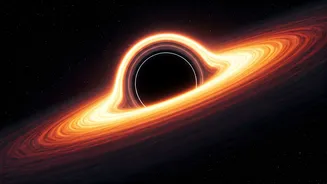
For half a century, astronomers have theorised that all black holes, no matter their size or appetite, should produce powerful outflows of material, often called 'black hole winds'. While these have been seen around actively feeding black holes in distant
galaxies, our own galactic centre seemed to be an exception. Sagittarius A (Sgr A) is on a famously meager diet, consuming the equivalent of a single grain of rice every million years. This quietness made detecting any wind incredibly difficult, leading to a long-standing astronomical puzzle. Now, scientists have finally found what they were looking for. Using data from the Atacama Large Millimeter/Submillimeter Array (ALMA), researchers have identified the first clear evidence of a wind blowing from Sgr A.
A Cosmic Carving
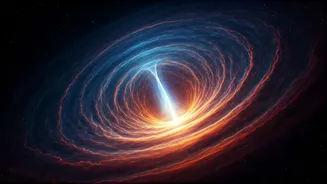
The discovery was not made by seeing the wind itself, but by observing its dramatic effect on the surrounding environment. Astronomers noticed a giant, cone-shaped hole in the cold gas located just a few light-years from the black hole. This cavity, which points directly at Sgr A*, is precisely what you’d expect to see if a powerful outflow was carving its way through the dense molecular clouds. When researchers overlaid their radio observations from ALMA with X-ray data from NASA's Chandra X-ray Observatory, the picture became even clearer. The cone-shaped void in the cold gas was filled with hot, X-ray-emitting gas, confirming that an energetic wind from the black hole had swept the area clean or heated the material up. This finding provides the most detailed view yet of how our central black hole interacts with its surroundings.
Our Black Hole Isn't So Unusual
One of the most significant implications of this discovery is that Sgr A is not as unique as it once seemed. The presence of this wind, even though it is relatively weak compared to the 'fireworks' seen in more active galaxies, shows that our black hole behaves like others, just on a much quieter scale. This is important because most supermassive black holes in the universe are believed to be in a dormant, or quiet, state for most of their lives. We usually only get to study them when they are brightly and actively feeding. Sgr A offers a rare window into the typical, dominant state of a black hole’s life, helping scientists build a more complete picture of galactic evolution. Researchers estimate this wind has been active for at least 20,000 years, providing a long history of its influence.
Rewriting the Galactic Rulebook
This discovery forces a change in how scientists model the environment at the galactic centre. For a long time, the region was seen as a chaotic place where gravity was the main force, pulling gas and dust inward. Now, it's clear there is also a significant outward force at play. This pushback from the black hole's wind has likely shaped the distribution and temperature of gas near the galaxy's core for millennia. It helps explain structures and past events that were previously a mystery, including evidence of ancient eruptions and outflows that created giant structures like the Fermi Bubbles, which extend far above and below the galactic plane. Understanding this wind is a crucial step towards a more complete model of how our galaxy's heart really beats.