


A Galactic Cold Case
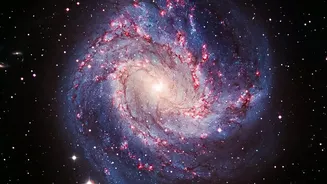
For years, astronomers have been puzzled by a strange feature of our galaxy. While stars in the main disc, including our Sun, orbit the galactic center at a brisk 220 kilometers per second, the stars in the vast, sparse cloud surrounding the disc, known
as the stellar halo, move much more slowly. These halo stars crawl along at a mere 25 kilometers per second, a discrepancy that hinted at a dramatic, untold story in our galaxy's history. Researchers at Durham University’s Institute for Computational Cosmology decided to investigate this mystery using powerful supercomputer simulations to model the evolution of Milky Way-like galaxies. Their findings, presented at the Royal Astronomical Society's National Astronomy Meeting, suggest this slow halo is the smoking gun of a cataclysmic event.
Enter the 'Gaia Sausage'
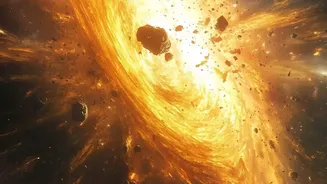
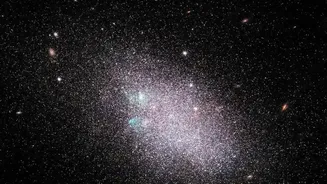
The prime suspect in this cosmic drama is a dwarf galaxy known colorfully as the Gaia Sausage. This name comes from the European Space Agency's Gaia satellite, which in 2018 mapped the movement of stars in our galaxy with unprecedented precision. It revealed a population of stars moving in highly elongated, radical orbits that, when plotted on a velocity graph, resembled a sausage shape. These stars are the remnants of a dwarf galaxy that slammed head-on into the young Milky Way between 8 and 11 billion years ago. Although it was a dwarf galaxy, the Gaia Sausage was immense, possessing a mass more than 10 billion times that of our sun before it was torn apart and its stars were absorbed by the Milky Way.
Flipping the Galaxy Like a Coin
The Durham simulations showed that a head-on collision with a galaxy the size of the Gaia Sausage could have a profound effect. According to the models, the gravitational chaos unleashed by the merger was powerful enough to exert a torque on the Milky Way's disc, causing it to precess, or wobble, like a spinning top that has been struck. Over hundreds of millions of years, this wobble could have intensified until the entire stellar disc flipped by more than 90 degrees, reorienting itself within its surrounding halo of dark matter. Lead researcher Kirill Batrakov noted this would not have been an instantaneous event, likely taking at least a few hundred million years to complete. The simulations consistently showed that galaxies ending up with slow-moving stellar haloes today were those that experienced both a Gaia Sausage-like merger and a major disc flip in their past.
Rewriting Our Galactic History
This discovery doesn't just solve the mystery of the slow-moving halo; it fundamentally changes how we view our galaxy's evolution. It suggests the Milky Way's current, relatively stable orientation is the result of a recovery from an incredibly violent upheaval. The collision didn't just scatter the Sausage galaxy's stars into our halo; it likely puffed up and fractured the Milky Way's original disc, which then had to regrow. This event also helps explain the formation of the Milky Way's 'thick disc,' a population of older stars with more chaotic orbits than those in the thin disc where our Sun resides. The idea that our own Sun might have once been on a completely different trajectory through the cosmos adds a new layer to our understanding of our place in the universe. This new chapter in our galaxy’s story provides crucial context for comparing the Milky Way to other galaxies and understanding the dynamic processes that shape them.