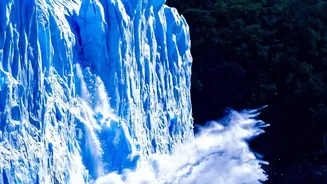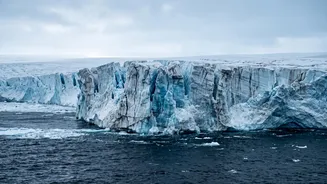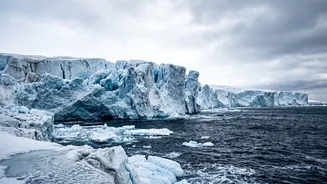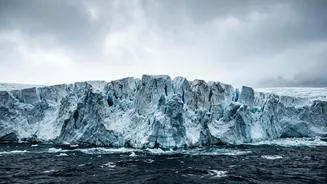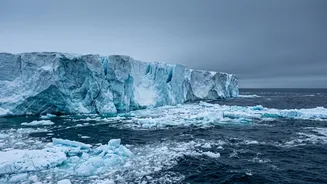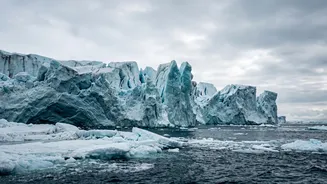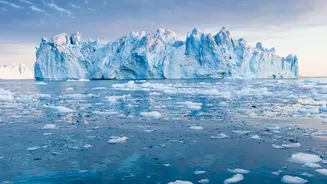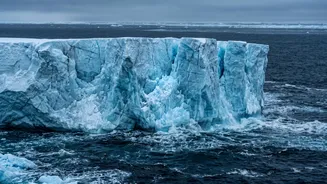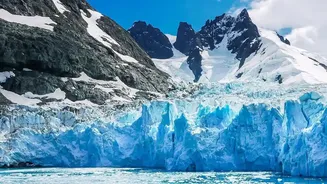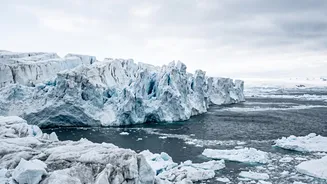




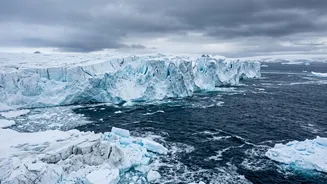
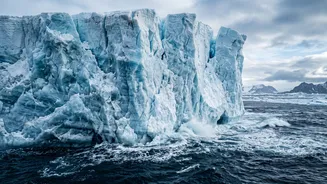
Antarctica's Thwaites Glacier, nicknamed the 'Doomsday Glacier' for its immense potential to raise global sea levels, is a focal point of climate research. Now, new findings are clarifying how scientists predict its future.
Why Is This Glacier a Global Concern?
Thwaites is one of the largest
and fastest-melting glaciers on Earth. Roughly the size of Great Britain or the US state of Florida, it sits in West Antarctica, acting like a cork in a bottle. It currently holds back a vast quantity of inland ice, and its own melt already contributes to about 4% of annual global sea-level rise. Scientists are intensely focused on it because its total collapse could raise sea levels by over two feet (65 cm). More critically, its failure could destabilise the entire West Antarctic Ice Sheet, which holds enough ice to raise sea levels by a catastrophic 10 feet.
The Challenge: Predicting the Melt
For years, scientists have used computer models to project how quickly Thwaites might melt. However, these projections often struggled to match the real-world changes observed by satellites. The glacier has been thinning and retreating rapidly, but the complex processes happening thousands of feet below the ice surface, where it meets the ocean and the seabed, have been difficult to incorporate into models. The key area of uncertainty has been the 'grounding line'—the boundary where the glacier lifts off the land and begins to float on the ocean. This zone is crucial for the glacier's stability.
New Research Rewrites the Model
Recent research published in the journal Nature Communications has provided a major breakthrough. Scientists from the University of California, Irvine, and NASA's Jet Propulsion Laboratory developed a new model that better reflects reality. Using satellite data, they discovered that previous models were too simplistic. Instead of a neat, narrow grounding line, there is a wide 'grounding zone' several kilometres across. In this zone, warm, salty ocean water is pushing far beneath the grounded part of the glacier. As tides rise and fall, this water repeatedly lifts the ice, melting it vigorously from below.
Projections Double, Even Without More Warming
By incorporating this newly understood 'grounding zone' dynamic, the updated model produced alarming results. It suggests that Thwaites could contribute up to 30 millimeters (1.2 inches) to global sea-level rise by the year 2100. This is double the amount projected by older models. Perhaps most concerning is that this projection holds true even without any additional climate warming beyond current conditions. The new model, which now more accurately reproduces the glacier's observed changes over the past few decades, suggests past projections may have significantly underestimated the threat.
What This Means for India's Coastline
For a nation like India with a 7,500-kilometre coastline and major metropolises like Mumbai, Chennai, and Kolkata near sea level, more accurate projections are critical. A rise of 30 millimeters from a single glacier may not sound like much, but it magnifies the risk and frequency of coastal flooding, storm surges, and saltwater intrusion into freshwater sources. This new research underscores the urgency of preparing coastal infrastructure and communities for a future with higher sea levels. The findings also highlight a grim reality: some level of future ice loss from Thwaites may already be unavoidable due to past warming, making mitigation and adaptation efforts all the more vital.