






The Foundation of At-Home Strength
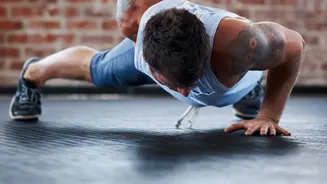
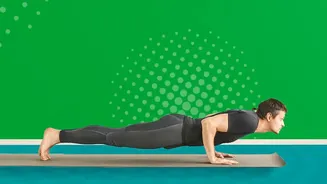
Household resistance training is a broad term for using your own body weight and common objects to create a workout. Think push-ups, squats, planks, and lunges — exercises that form the non-negotiable foundation of strength. You can also get creative,
using filled water bottles or a backpack loaded with books as makeshift weights. The beauty of this approach lies in its accessibility. It's free, can be done anywhere, and is an excellent way for beginners to learn fundamental movement patterns like pushing, pulling, squatting, and hinging without the risk of injury from heavy weights.
The Key Principle: Progressive Overload
Muscles grow stronger when they are forced to adapt to a challenge that's slightly beyond their current capacity. This is called progressive overload. In a gym, you simply add more weight to the bar. At home, you have to be more creative. To apply progressive overload without traditional weights, you can increase your repetitions or sets, reduce rest times between exercises, or slow down the movement to increase time under tension. The most effective method, however, is progressing to more difficult variations of an exercise. For example, once regular squats feel easy, you can move to a Bulgarian split squat; once push-ups are no problem, you can elevate your feet to make them harder.
Your At-Home Workout Toolkit
Building a solid routine doesn't require any fancy purchases. Your own body is your primary tool. Foundational exercises like bodyweight squats, push-ups (on knees or toes), planks, and lunges target all major muscle groups. For pulling movements, which can be tricky at home, you can use a sturdy towel hooked around a doorknob for rows. A heavy backpack can be used for squats and lunges, while jugs of water or milk can substitute for dumbbells in exercises like overhead presses or bicep curls. The goal is to find safe ways to add resistance and challenge your muscles with items you already own.
The Inevitable Plateau
Herein lies the catch mentioned in the headline. While household resistance is fantastic for building a base of fitness and maintaining muscle, you will likely hit a plateau. Your body is incredibly adaptive, and eventually, there's a limit to how challenging you can make bodyweight exercises. For those with goals of significant muscle growth (hypertrophy) or maximal strength, the ability to incrementally add heavy loads at a gym becomes almost essential. At a certain point, a backpack with books simply can't replicate the stimulus of a heavy barbell squat, and it becomes difficult to keep applying progressive overload effectively.
When and How to Transition to a Gym
So, how do you know when you've outgrown your living room? If your fitness goals have evolved, your progress has stalled for weeks despite making your workouts harder, or you simply feel you need more options, it might be time to consider a gym. The transition doesn't mean abandoning what you've learned. The foundation of strength and proper form you built at home is a huge advantage. You can start by mapping your home exercises to gym equipment: bodyweight squats become goblet squats, push-ups can be supplemented with the bench press, and towel rows can be replaced with cable rows or lat pulldowns. Think of the gym not as a replacement, but as an expansion of your toolkit.