


Reading a Neighbor's Biography
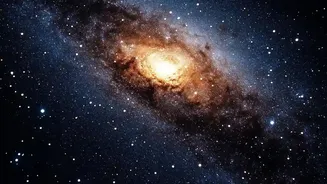
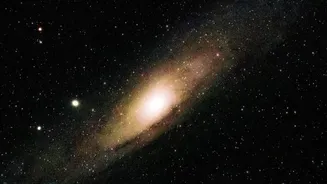
At 2.5 million light-years away, the Andromeda galaxy is a twin to our Milky Way, a massive spiral that’s the most distant object visible to the naked eye. This proximity makes it a perfect laboratory for understanding how large galaxies like ours live
and die. To read its history, astronomers embarked on an ambitious project called the Panchromatic Hubble Andromeda Treasury (PHAT). This decade-long effort used the Hubble Space Telescope to create a stunningly detailed mosaic, resolving more than 200 million individual stars. By studying the colors and brightness of these stars, scientists can create a 'fossil record' of the galaxy, determining when and where stars formed over billions of years. This provides an unprecedented outside-in view that’s impossible to get of our own Milky Way, since we are stuck inside it.
An Engine Sputtering
The massive survey delivered a surprising result: Andromeda is a galaxy whose best days are behind it. While it experienced a major burst of star-making activity about two billion years ago, possibly from an ancient galactic merger, its production has been slowing ever since. The study revealed a steady, 500-million-year decline in star formation that has become especially sharp in the last 40 million years. Five hundred million years ago, Andromeda was creating stars at a rate of about one solar mass per year, similar to the Milky Way today. Now, that rate has plummeted to just one-fifth of a solar mass per year, indicating a galaxy that is becoming increasingly quiescent.
The Fading Ring of Fire
The slowdown isn't happening uniformly across the galaxy. Much of the decline is driven by the fading of a huge, active ring of gas and dust located about 32,000 light-years from the galaxy's center. This ring has been Andromeda’s primary stellar nursery in its more recent history, responsible for a large portion of its new stars. As activity in this hyperactive region winds down, it drags the whole galaxy’s average rate down with it. Researchers say this isn't necessarily a case of the galaxy running out of fuel. Instead, it seems to be a natural winding-down period after its more frenetic youth. As one researcher described it, “It's just like after running a marathon, sometimes you've got to take a bit of a breather.”
A Case of a Bad Neighbor?
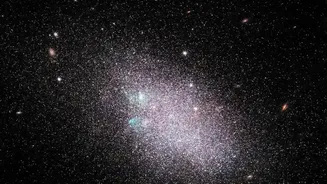
Astronomers also investigated whether an external force could be at play. A prime suspect is M32, a small, compact satellite galaxy that appears close to Andromeda's disk. By studying the history of star formation in the area around M32, researchers found a noticeable drop in activity that began around 60 million years ago, a pattern not seen elsewhere. While scientists can't definitively say M32 is the culprit behind the localized slowdown, its proximity makes it the most likely suspect for disrupting the gas and dust in that region, effectively stifling star birth. This adds another layer of complexity to Andromeda's history, suggesting its evolution has been shaped by both internal processes and external interactions.
A Glimpse of the Future
Andromeda’s story of fading star birth offers a potential preview of our own galaxy's distant future. While the Milky Way is currently more active, it will eventually exhaust its gas reserves and settle into a quieter state. However, the story isn’t over. The Milky Way and Andromeda are on a collision course, set to merge in about 4.5 billion years. While some recent models have questioned the certainty of a direct merger, most evidence still points to a future collision. This cataclysmic event will throw the newly combined galaxy, sometimes dubbed 'Milkomeda,' into a new, spectacular era of star formation, using the combined gas and dust of both galaxies to light up the cosmos once more before eventually fading.