






A World That Continues to Surprise
When NASA’s New Horizons spacecraft flew past Pluto in 2015, it sent back images that transformed our understanding of the dwarf planet. Instead of a static, cratered wasteland, we saw towering mountains of water ice, vast plains, and a giant, heart-shaped
glacier. That feature, known as Tombaugh Regio, and particularly its western lobe, Sputnik Planitia, has become a focal point for scientists. Its lack of impact craters suggests its surface is shockingly young, constantly being renewed by geological activity. A recent analysis of the New Horizons data, published in the Planetary Science Journal, adds another astonishing layer: evidence that liquid may have recently flowed on its surface.
Not Water, But Liquid Nitrogen
On a world where surface temperatures plummet below -200°C, liquid water is impossible. The “liquid” in question is nitrogen. Sputnik Planitia is a massive basin filled with frozen nitrogen several kilometres deep. While Pluto’s frigid atmosphere can’t produce nitrogen rain, researchers propose another mechanism. Computer models suggest that heat from Pluto's interior could be just enough to melt the nitrogen ice at the very bottom of this massive glacier. This liquid nitrogen, being less dense than the solid ice above it, would become buoyant. It could then be forced upwards through cracks and fissures in the ice sheet, a process some have compared to volcanic dike systems on Earth.
Following the Evidence
This theory isn’t just based on models. Scientists led by Alan Stern, the principal investigator for the New Horizons mission, re-examined images of Sputnik Planitia. They noticed dark streaks and diffuse patches along the boundaries of large, polygonal convection cells on the glacier's surface. These patterns look remarkably similar to features seen on Earth's own ice sheets, like in Greenland, where meltwater darkens the surface. The team concluded that the best explanation for these dark features on Pluto is that liquid nitrogen has temporarily “wetted” the surface before refreezing. This suggests these flows are not just an ancient phenomenon but could be happening in Pluto's recent past or even today.
A New Kind of Plumbing System
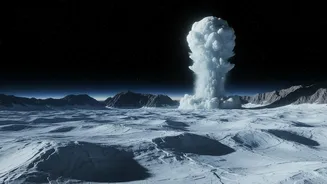
The eruptions would likely not be a slow, steady trickle. Researchers calculate that the flow would need to happen in short, intense pulses. These events could release hundreds of thousands of cubic metres of liquid nitrogen over hours or days, enough to spread out and create the dark markings seen by New Horizons. This suggests a new kind of time-variable feature on Pluto, a world previously thought to be largely unchanging. The discovery places Pluto in a fascinating category of celestial bodies, including moons like Triton and Enceladus, that exhibit cryovolcanism—volcanoes that erupt icy volatiles instead of molten rock.
Redefining an 'Active' World
The idea of a subsurface plumbing system pushing liquid nitrogen to the surface fundamentally changes our perception of Pluto. It proves that a world doesn't need to be close to the sun to be geologically dynamic. Internal heat, even if limited, can drive surprising processes on the most distant objects in our solar system. This finding suggests that Pluto is not a frozen relic but a living world in its own right, with complex processes shaping its surface over time. More than half of Pluto's surface has yet to be mapped in high resolution, leaving open the tantalizing possibility that similar features exist elsewhere on the dwarf planet, waiting to be discovered.