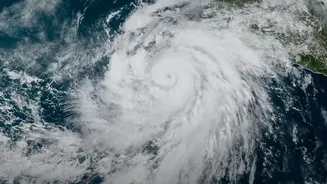







For India's cyclone-prone coasts, every hour of warning counts. Now, a revolution in weather forecasting is underway, powered by Artificial Intelligence that promises to predict deadly storms faster and more accurately than ever before.
A New Era in Forecasting
The annual cyclone
season is a period of high alert for millions along India's vast coastline. For generations, we have relied on traditional weather prediction, a complex process involving supercomputers solving immense physics equations. These numerical weather prediction (NWP) models have been the bedrock of storm warnings, but they are time-consuming and computationally expensive, often taking hours to generate a forecast. Today, that is changing. A new frontier has opened with the arrival of AI-driven weather models. Names like Google's GraphCast and NVIDIA's FourCastNet are not just tech buzzwords; they represent a fundamental shift in how we anticipate nature's fury. These models learn from decades of historical weather data, identifying patterns in the atmosphere that even the most advanced physics-based systems struggle to compute.
How AI Outpaces Tradition
Traditional models simulate the physics of the atmosphere, a painstaking process requiring enormous computing power. An AI model works differently. By training on vast datasets—up to 40 years of global atmospheric data—it learns the relationships between variables like pressure, wind, and temperature. Instead of solving equations from scratch, it predicts the next state of the weather based on patterns it has seen before. The result is a dramatic increase in speed. A 10-day forecast that takes a traditional supercomputer hours can be generated by an AI model like GraphCast in under a minute on a single specialised machine. This speed allows for the rapid creation of large 'ensemble' forecasts, where hundreds of possible storm scenarios can be run, giving meteorologists a much clearer picture of the risks and uncertainties.
More Time, More Lives Saved
The primary benefit of this new technology is time. In multiple instances, AI models have predicted a hurricane's path days earlier than their traditional counterparts. During Hurricane Lee in 2023, GraphCast accurately predicted its landfall in Nova Scotia nine days in advance, while conventional models only confirmed the location about six days out. This 'extra day' of warning is invaluable. It allows disaster management authorities more time to issue evacuation orders, secure critical infrastructure like power grids and hospitals, and position emergency services. For businesses, it means more time to protect assets and reroute supply chains. Studies have shown that just a 24-hour advance warning can reduce a storm's economic damage by 30%. In a country as populated as India, that extra time translates directly into saved lives and livelihoods.
The Indian Context
The India Meteorological Department (IMD) is already exploring this powerful new technology. The Ministry of Earth Sciences has confirmed that three AI-based global weather models—GraphCast, Pangu, and FourCastNet—are being tested. The IMD has established a dedicated group to work on the application of AI and machine learning in weather and climate forecasting. While AI is already being used to help estimate cyclone intensity, its application for tracking is seen as a game changer. Dr. Mrutyunjay Mohapatra, the Director General of IMD, has noted that complementing physics based models with AI can generate forecasts much faster, a crucial advantage when dealing with fast developing systems in the Bay of Bengal and Arabian Sea. The government has also developed a Web GIS based platform, the Multi Hazard Early Warning Decision Support System (MHEW DSS), which integrates these advanced models to support timely decision making.
The Road Ahead
Despite its incredible potential, AI is not a silver bullet. Experts are clear that it is a tool to assist, not replace, human meteorologists and traditional models. AI models can sometimes be a 'black box', making it difficult to understand why they make a certain prediction, which can be unsettling in an emergency. They have also shown limitations in accurately predicting a storm's intensity, especially rapid intensification, and forecasting extreme rainfall. The future, therefore, lies in a hybrid approach. Human forecasters will remain essential, using their expertise to interpret outputs from both traditional and AI models to create the most accurate and reliable warnings. The rapid pace of improvement in AI, however, is undeniable. Advancements that once took a decade in weather science are now happening in the span of a single year, promising an ever safer future for our coastal communities.