


The Universe's Alchemists
For decades, scientists have known that elements like carbon and iron are forged in the fiery hearts of stars. But where do heavier, rarer elements like gold, platinum, and uranium come from? The answer, it turns out, is far more cataclysmic. The leading
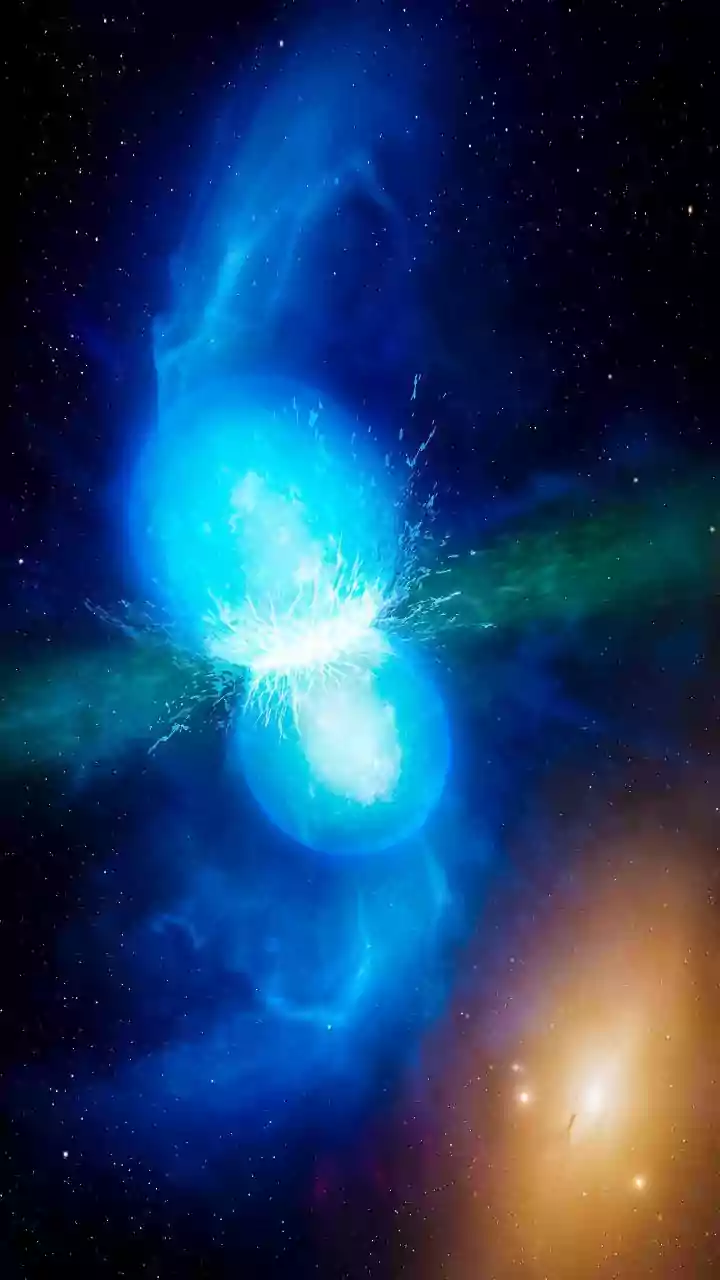
theory points to the violent collision of two neutron stars. Neutron stars are the incredibly dense collapsed cores of massive stars that have exploded. A mere teaspoon of neutron star material would weigh a billion tonnes on Earth. When two of these stellar remnants, locked in a decaying orbit, finally smash into each other, the resulting explosion is called a kilonova. This event unleashes a tremendous amount of energy and a flood of neutrons, which are rapidly captured by atomic nuclei to create the universe's heaviest elements.
A Glimmer in Our Own Galaxy
The focus of this new, yet-to-be-peer-reviewed study is a source of high-energy gamma rays known as HESS J1507−622. First detected over a decade ago by telescopes in Namibia, its origin has been a long-standing puzzle. What made it peculiar was its emission of gamma rays without any corresponding radio waves or X-rays, and its location away from the main plane of the Milky Way where most stars reside. Researchers now propose that this mysterious glow is the remnant of a kilonova. Led by scientists from the Chinese Academy of Sciences and the University of Notre Dame, the team suggests this collision happened relatively recently in cosmic terms—perhaps less than 1,000 years ago—which would explain why the glowing cloud of debris is still so bright and compact.
The Significance of a Local Find
While astronomers have detected kilonovae before, they have always been in distant galaxies, millions of light-years away. If confirmed, HESS J1507−622 would be the very first kilonova remnant identified within our own Milky Way galaxy. This presents an unprecedented opportunity for study. A local source would allow scientists to observe the aftermath of a neutron star merger in stunning detail, helping to confirm their models of heavy element formation. The researchers estimate that the collision would have been incredibly bright, perhaps shining as vividly as Jupiter in our night sky. However, its position in the southern sky might explain why it wasn't recorded by ancient astronomers in China or Europe, who kept meticulous records of celestial events like supernovae.
From Candidate to Confirmation
It is crucial to remember that the study is preliminary and has been posted on the preprint server arXiv, meaning it has not yet undergone formal peer review. The authors themselves label the kilonova explanation as a 'compelling hypothesis'. While the theory elegantly explains many of the puzzling features of HESS J1507−622, more work is needed for confirmation. The next steps will involve further observations to analyse the light from the remnant, searching for the specific chemical fingerprints of heavy elements like gold and platinum. Alternative theories, such as those involving magnetars (highly magnetized neutron stars) or unusual supernovae, must also be definitively ruled out. Future observations will be key to solidifying this exciting possibility and potentially rewriting our understanding of the Milky Way's recent history.