




The Ghost in the Data
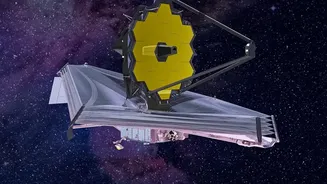
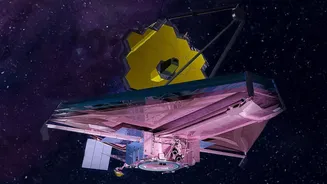
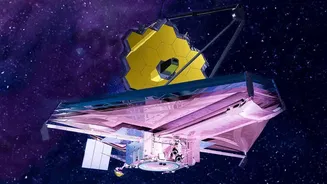
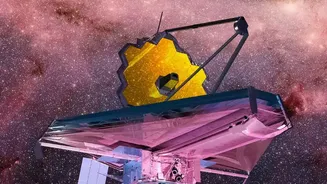
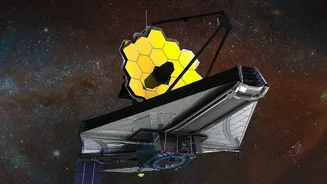
A team of astronomers, led by postdoctoral researcher Aidan Gibbs at the University of California, San Diego, was using the Webb telescope to study a well-known planetary system called Beta Pictoris, located about 63 light-years from Earth. Their goal
was to analyze a known planet, not find a new one. But as they sifted through the data from Webb’s powerful Near-Infrared Spectrograph (NIRSpec), something odd appeared. Instead of the smooth data they expected from light bouncing off cosmic dust, there was a distinct, patterned signal—a chemical 'barcode' of sorts. It was a complete surprise. “We weren't looking for a new planet,” Gibbs stated. “Then, this telltale signal appeared in the data where we didn't expect it.”
From Anomaly to Exoplanet
In astronomy, an unexpected bright spot or signal can often be an instrument error or a feature of the background. However, this signal was different. It showed the specific absorption lines of carbon monoxide, a key indicator of a giant planet’s atmosphere. The system, Beta Pictoris, is famously shrouded in a bright disk of dust and debris, which acts like a cosmic fog, making it incredibly difficult to directly image planets orbiting within it. This is why previous searches had missed what the Webb data was now hinting at. Instead of trying to see through the fog, the team used spectroscopy to read the chemical fingerprint hidden in the light. By analyzing this chemical signature, they could confirm they weren't just looking at dust, but at the atmosphere of a massive, previously unknown object gravitationally bound to the star.
Meet Beta Pictoris d
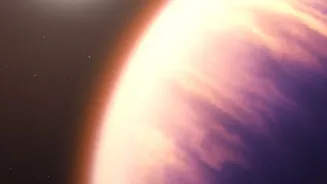
The newfound world was named Beta Pictoris d. It’s the third known planet in the system, and it is a behemoth. Astronomers estimate it has a mass at least twice that of our own Jupiter, making it the smallest of the three gas giants in that system but a giant nonetheless. It orbits its star at a distance comparable to Neptune's distance from our Sun. This position is particularly exciting for scientists because it places the planet just inside the inner edge of the system’s massive debris disk. For years, theorists predicted that an unseen planet had to exist in this exact spot to explain the disk's sharp, well-defined edge and other strange structures. The discovery of Beta Pictoris d proves those theories were likely correct; it appears to be the long-sought-after sculptor of its own solar system.
A New Way to Find Worlds
Beyond the excitement of finding a new planet, the discovery of Beta Pictoris d is significant because of how it was found. Traditional planet-hunting methods often rely on direct imaging, which is easily defeated by the glare of a star or a bright, dusty disk like the one at Beta Pictoris. This discovery demonstrates a powerful new technique. By focusing on the unique chemical signatures in the light spectrum, astronomers can effectively ignore the visual noise and identify planets that would otherwise remain hidden. This spectroscopic method doesn't just reveal a planet's existence; it immediately provides a wealth of information about its atmosphere, temperature, and motion. It opens up a new frontier for discovering worlds in high-glare environments that were previously impossible to search, proving the versatility and power of the James Webb Space Telescope's instruments.