



Hunting a Cosmic Ghost
Imagine a particle so small and so neutral that it can travel for billions of light-years, passing through planets, stars, and entire galaxies without leaving a trace. This isn't science fiction; this is a neutrino. Often called 'ghost particles', neutrinos
are born from the most violent events in the cosmos: exploding stars, gamma-ray bursts, and the churning hearts of active galaxies. They are the second most abundant particle in the universe, yet their reluctance to interact with anything makes them incredibly difficult to study. For astrophysicists, this is both a challenge and an opportunity. While light can be blocked by dust and gas, neutrinos sail straight through, carrying pristine information about their violent origins. For years, the biggest mystery was where the most energetic of these neutrinos came from. Scientists knew they were created in cosmic accelerators far more powerful than anything on Earth, but they couldn't pinpoint the source. It was like hearing a thunderclap without knowing where the lightning struck.
A Trap of Ice at the South Pole
To catch a ghost, you need a special kind of trap. For neutrinos, that trap is the IceCube Neutrino Observatory, a massive detector buried deep in the Antarctic ice. It consists of over 5,000 light sensors strung across a cubic kilometre of pristine, ultra-clear ice, located 1.5 to 2.5 kilometres below the surface. Here's how it works: on the very rare occasion that a high-energy neutrino happens to collide with an atom in the ice, it produces a shower of secondary particles. These particles, moving faster than light in the ice, create a cone of blue light known as Cherenkov radiation. The sensors detect this faint flash, recording its timing and intensity. By analysing the pattern of light, scientists can reconstruct the neutrino’s original energy and, most importantly, the direction it came from. This giant, frozen telescope isn’t looking up at the sky, but rather through the Earth, using our planet as a filter to block out other, less interesting cosmic particles.
The Dusty Culprit Is Revealed
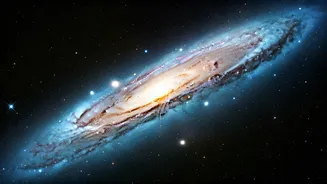
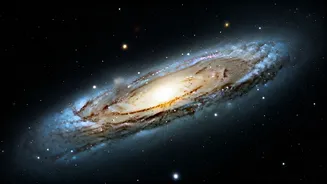
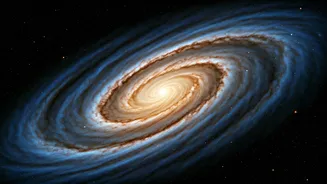
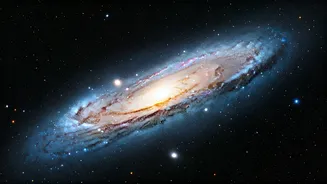
After years of patient observation, IceCube hit the jackpot. The observatory detected a significant excess of high-energy neutrinos—around 80 of them—streaming from a single point in the sky. That point was the galaxy NGC 1068, also known as Messier 77, located about 47 million light-years away in the constellation Cetus. Messier 77 is what’s known as an active galaxy, meaning its core is powered by a supermassive black hole. Crucially, it is also a very dusty galaxy. From our perspective, a thick torus of dust and gas obscures the galaxy’s bright core, blocking most of the light and gamma rays that would normally be visible. This is precisely why the neutrino signal is so important. While gamma rays get absorbed by the dust, the neutrinos fly right through. This makes NGC 1068 the perfect cosmic suspect: a source powerful enough to create high-energy neutrinos but shrouded in a way that only neutrinos could escape to tell the tale. This discovery was the first time scientists have found a steady source of high-energy neutrinos, providing a crucial piece of the puzzle.
A New Window on the Universe
This discovery is more than just solving a cosmic mystery; it marks the true beginning of a new field: high-energy neutrino astronomy. For centuries, we have studied the universe through light, using telescopes that capture everything from radio waves to gamma rays. But light can be deceptive, blocked and scattered by intervening dust. Neutrinos offer a new, unobstructed view into the most extreme environments in the cosmos. By combining neutrino data with observations from light-based and gravitational-wave astronomy—a practice known as multi-messenger astronomy—scientists can get a complete picture of events like the birth of black holes or the collision of stars. The identification of Messier 77 as a neutrino source provides a 'standard candle' for this new field, a well-studied object that can be used to calibrate future neutrino telescopes. We can now peer behind the 'black-out curtain' of matter that surrounds supermassive black holes and study the engines that power these cosmic behemoths directly.