



India's Sentinel at L1
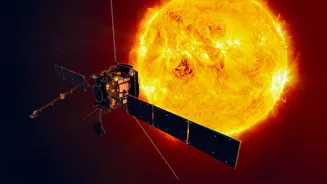
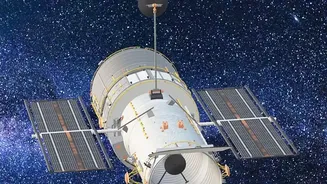
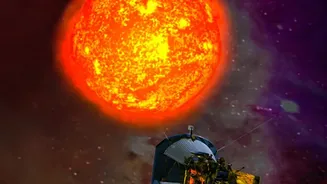
India's first dedicated solar observatory, Aditya-L1, is a testament to the nation's growing prowess in space science. Launched by ISRO in September 2023, it travelled to a unique spot in space, the Sun-Earth Lagrange point 1 (L1), about 1.5 million kilometres
from Earth. From this vantage point, it gets a continuous, uninterrupted view of the Sun. Aditya-L1 is equipped with seven sophisticated instruments designed to study everything from the Sun’s surface to its outermost atmosphere, the corona. Its primary payload for this collaboration is the Visible Emission Line Coronagraph (VELC). Developed by the Indian Institute of Astrophysics, VELC is designed to study the corona very close to the Sun's limb, providing crucial data on the temperature, velocity, and density of the solar wind and the drivers of space weather.
Europe's Artificial Eclipse in Space
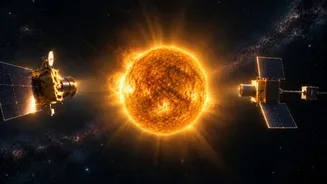
The European Space Agency's (ESA) Proba-3 mission, launched in December 2024 aboard an Indian PSLV rocket, is a marvel of precision engineering. It isn't a single satellite but a pair of spacecraft flying in perfect formation, about 150 metres apart. One spacecraft, the 'Occulter', flies in front and precisely blocks the bright face of the Sun. This allows the second spacecraft, the 'Coronagraph', to observe the Sun's incredibly faint corona without being blinded by the star's glare. In effect, Proba-3 creates a near-perfect artificial solar eclipse for hours at a time, something that natural eclipses on Earth can only offer for a few minutes. This unique setup allows its ASPIICS instrument to capture incredibly detailed images of the corona, revealing the structure and movement of plasma eruptions.
Two Missions, One Shared Vision
The true power of this partnership lies in how the two missions complement each other. Aditya-L1's VELC provides spectroscopic data, which means it analyses the properties of light to understand the physical characteristics of the coronal plasma, like its temperature and density. Proba-3's ASPIICS, on the other hand, provides sharp, high-resolution images, detailing the shape, dynamics, and mass of solar eruptions. Think of it as Aditya-L1 being the scientist who tells you what the material is and how hot it is, while Proba-3 is the photographer who shows you exactly what it looks like and how it's moving. This combination is especially powerful for studying Coronal Mass Ejections (CMEs), massive bursts of plasma and magnetic fields from the Sun.
A More Complete Picture of Solar Eruptions
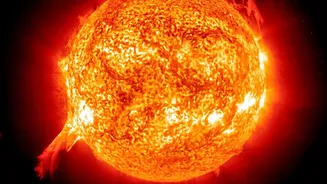
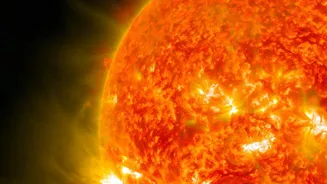
Observing CMEs in their earliest moments, very close to the Sun's surface, has always been a major challenge for scientists. This observational gap has limited our understanding of how these powerful events gain their energy. Recent joint observations have demonstrated the power of this new collaboration. In September 2025, both missions simultaneously recorded two different CMEs. Aditya-L1's VELC captured the eruptions at their earliest stages, while ASPIICS tracked their structural evolution. By combining the data, researchers from the Indian Institute of Astrophysics and their international partners were able to cross-check their calculations for the eruptions' mass, density, and energy, providing a much more complete and reliable picture than either mission could achieve alone.
Why This Matters for Earth
This research isn't just academic. CMEs are a primary driver of space weather, which can have significant impacts here on Earth. When a powerful CME is directed towards our planet, it can disrupt satellite operations, interfere with GPS and communication systems, and even damage power grids. By better understanding the physics of how these eruptions form and accelerate near the Sun, scientists can improve their models for predicting their arrival and potential impact on Earth. The synergy between Aditya-L1 and Proba-3 represents a major step forward in this effort, providing crucial data that will feed into future space weather forecasting systems.