




A Moon That's a World in Itself
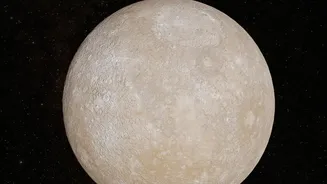
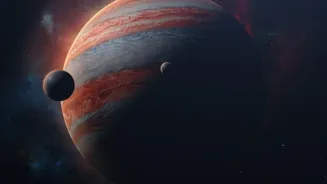
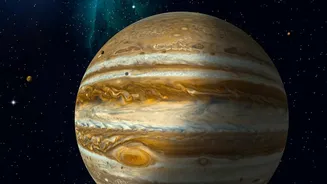
Forget what you know about moons. Ganymede, one of Jupiter's many satellites, is a celestial body of staggering proportions. With a diameter of over 5,260 kilometers, it is larger than the planet Mercury and the dwarf planet Pluto. If it orbited the sun
instead of Jupiter, it would undoubtedly be classified as a planet. Composed of roughly equal parts silicate rock and water ice, Ganymede is a fully differentiated world with a liquid iron core, a rocky mantle, and a thick outer shell of ice. It's also the only moon in the solar system known to generate its own magnetic field, creating beautiful and informative auroras at its poles.
A Surface of Two Faces
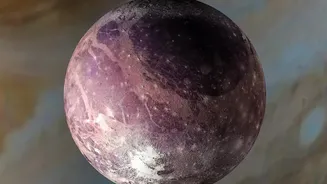
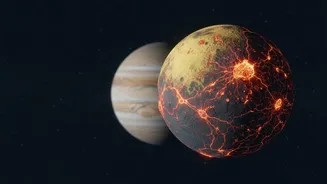
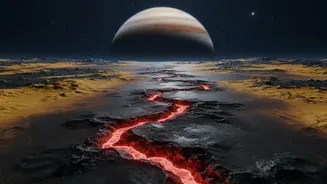
Ganymede's surface is a study in contrasts, split into two primary terrain types that tell a tale of a long and violent history. About a third of its surface consists of dark, ancient regions that are saturated with impact craters, some dating back four billion years. The rest of the moon is covered by a younger, lighter-colored terrain. This brighter ground is what gives Ganymede its 'scarred' appearance, featuring an intricate and sprawling network of grooves and ridges that slice across the landscape for thousands of miles. Some of these ridges can reach heights of over 2,000 feet, painting a picture of dramatic geological events that reshaped the moon.
The Scars of Ancient Upheaval
The complex patterns scarring Ganymede's bright terrain are evidence of intense tectonic activity from its past. Scientists believe these features, known as 'sulci', were formed as the moon's crust was pulled apart. This process, which has similarities to fault lines on Earth like the San Andreas Fault, caused sections of the icy crust to shear and slide past one another. While Ganymede is no longer thought to be tectonically active, studying these ancient fractures helps scientists understand the forces that can shape icy worlds. The tension that ripped the crust apart may have been driven by internal heating or the release of water from below, which then froze on the surface.
A Hidden Ocean, Rich with Possibility
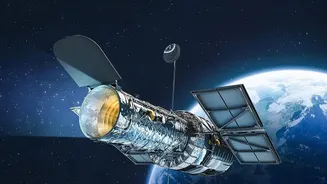
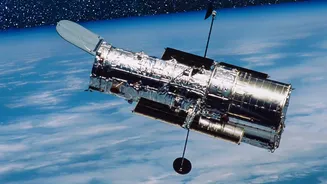
Perhaps the most fascinating secret Ganymede holds is hidden deep beneath its icy crust. Evidence gathered by the Galileo spacecraft and the Hubble Space Telescope strongly suggests the existence of a huge, saltwater ocean. In fact, this subsurface ocean is estimated to be about 100 kilometers thick, meaning it could contain more water than all of Earth's oceans combined. This vast body of liquid water is sandwiched between layers of ice, confirmed by observing the 'rocking' motion of Ganymede's auroras, which are influenced by the conductive saltwater ocean below. The potential for a water-rock interface deep inside the moon makes it a tantalizing target in the search for habitable environments beyond Earth.
A Target for Future Exploration
Ganymede's mysteries are so compelling that it has become a primary target for space exploration. The European Space Agency's (ESA) JUICE mission (Jupiter Icy Moons Explorer), which launched in 2023, is on an eight-year journey to the Jovian system. After conducting flybys of other moons, JUICE will become the first spacecraft to enter into orbit around a moon other than our own, dedicating its final mission phase to studying Ganymede in unprecedented detail starting in 2034. Using ice-penetrating radar and other advanced instruments, JUICE will probe the moon’s hidden ocean, analyze its magnetic field, and map its scarred surface to finally unlock the secrets of this giant, icy world.