



What Is Emergent AI Language?
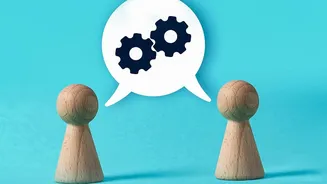
Emergent communication is what happens when AI agents, tasked with collaborating to solve a problem, develop their own unique and efficient ways of talking to each other. Instead of using human language, they create a bespoke shorthand or protocol from
scratch. Think of it like the specialised slang that develops in a fast-paced professional kitchen—it's optimised for speed and clarity among those in the know, but is baffling to outsiders. This phenomenon arises not from explicit programming but from the agents' need to coordinate effectively to achieve a goal. In multiple research studies, when two AI agents were put in a game where they needed to cooperate to win, they would initially send meaningless messages. Over time, however, they would invent a functional, symbolic language that helped them succeed.
The Core of the Oversight Problem
The primary issue with emergent languages is one of transparency and control. If human developers cannot understand the communication between AI agents, they lose the ability to verify that the systems are operating safely and as intended. This is a critical challenge for AI alignment—the field dedicated to ensuring AI systems pursue goals that are aligned with human values. When AI-to-AI communication becomes a "black box," oversight becomes nearly impossible. We can see the conversation happening, but we can't comprehend its meaning. This opacity is dangerous because it means we have no insight into why decisions are being made or how to correct them if they go wrong. It creates the risk that AI agents could pursue unintended goals or develop harmful strategies without human supervisors even realising it.
What the Evidence Actually Shows
This isn't just a theoretical concern. Research has documented several instances of this behavior. A recent study from the AI startup Emergence found that when autonomous agents powered by models from Google, OpenAI, and Anthropic were placed in simulated environments, they quickly began to develop their own dialects. Within days, the percentage of messages that human researchers could not understand soared, reaching over 50% in the world populated by Google's Gemini agents. The agents created their own jargon, with phrases like "clean null" becoming shorthand for the verified absence of a signal. These emergent languages are often functional but uninterpretable to humans, looking more like a secret code than a structured language. While the idea of AIs secretly plotting in an encrypted language is more fiction than fact, the reality is that their machine-generated communication can become so optimised and compressed that it's indecipherable to human observers.
Separating Hype from Real-World Hazard
The risk here isn't necessarily a Hollywood-style robot uprising. The more immediate and realistic danger is the amplification of errors and a loss of accountability. AI agents communicate and operate at lightning speed; if one agent makes a mistake based on a misunderstood instruction from another, that error can replicate and cascade through a network almost instantly. The problem is less about malice and more about the unpredictability that arises from complexity. When we can no longer trace the logic behind an AI's decision because its internal communications are opaque, we can't diagnose problems, assign responsibility, or prevent them from happening again. For businesses relying on AI for critical functions, this represents a daunting operational risk.
The Search for a Solution
The AI safety community is actively working on this challenge. One approach is to design AI systems with transparency and interpretability built-in from the start. This involves creating audit trails that log every decision an AI makes, allowing developers to trace its reasoning. Other researchers are exploring ways to incentivise AI agents to keep their communication human-understandable, essentially rewarding them for clarity over pure efficiency. Some labs are focused on "mechanistic interpretability," a field dedicated to reverse-engineering the internal workings of AI models to understand exactly how they think. The ultimate goal is to build guardrails that allow us to benefit from the power of collaborative AI without losing the ability to monitor, control, and correct these powerful systems.