




The Planet's Fiery Heart
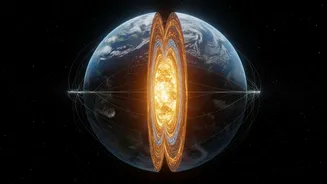
Deep inside Earth, starting around 2,900 kilometres down, lies the outer core. It's a turbulent world, a sphere of liquid iron and nickel hotter than the surface of the sun. This superheated, electrically conducting fluid is in constant motion. As it
swirls around the solid inner core, it acts like a colossal dynamo, generating the magnetic field that envelops our planet. This field is vital for life, deflecting harmful charged particles from the sun and providing the basis for all navigation, from ancient compasses to modern GPS. For years, scientists believed the large-scale flow of this liquid metal was relatively stable, dominated by a steady westward drift.
A View from Above
Peering into the core is one of the greatest challenges in geophysics. It can’t be seen or directly sampled. Instead, scientists rely on indirect clues. One of the best methods is to watch the magnetic field it produces. Space agencies like the European Space Agency (ESA) use highly sensitive satellites, such as the Swarm constellation, to map this field with incredible precision. Launched in 2013, these satellites can distinguish the magnetic signature of the core from other sources like the crust and oceans. By tracking tiny fluctuations in the field over time, scientists can infer the speed and direction of the molten iron flowing deep below.
The Unexpected Reversal
Analysis of satellite and ground-based data from 1997 to 2025 has upended previous assumptions. Around 2010, a huge patch of the core's flow deep beneath the Pacific Ocean did something completely unexpected: it reversed direction. What was previously a weak westward flow abruptly switched to a strong eastward one. This discovery was a shock, suggesting the dynamics of the core are far more volatile and can change much more rapidly than previously thought. The cause of this sudden reversal remains a mystery, but its detection marks a significant leap in our ability to observe our planet's deepest interior. Interestingly, recent analysis suggests this eastward surge has been weakening since 2020, adding another layer to the puzzle.
Geomagnetic 'Jerks' and Core Dynamics
This reversal is linked to another strange phenomenon known as a "geomagnetic jerk". These are sudden, sharp changes in the Earth's magnetic field that occur unpredictably every decade or so. They are thought to be caused by hydromagnetic waves or buoyant blobs of molten material rising rapidly within the core, which disrupt the flow and generate these jolts. The 2010 core-flow reversal beneath the Pacific is believed to be connected to a geomagnetic jerk observed in 2017. Understanding these events is crucial, as they can temporarily throw off global magnetic models used for critical navigation systems.
Why the Core's Behaviour Matters
These deep-Earth processes are not just academic curiosities. The stability of the magnetic field is essential for protecting our atmosphere from being stripped away by the solar wind, a fate that befell Mars. Changes in the core's flow directly impact the strength and structure of this protective shield. While a full-on magnetic pole reversal is a process that takes thousands of years, sudden regional shifts and jerks demonstrate how quickly the engine of our planet can change. Studying these events helps scientists build better models to forecast the magnetic field's long-term evolution and understand the fundamental forces that make Earth a habitable planet.