

A Glimpse into the Cosmic Dawn
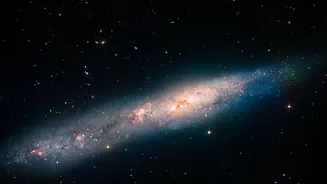
Astronomers pointed the powerful infrared eye of the James Webb Space Telescope (JWST) at a faint, distant object known as J0148-4214. This isn't just any galaxy; its light has travelled for over 12.5 billion years to reach us, meaning we are seeing it as it was
when the universe was just a toddler, approximately 1.2 billion years old. In this ancient epoch, known as the cosmic dawn, the very first galaxies and stars were forming. One of the biggest mysteries from this era is how supermassive black holes, millions or billions of times the mass of our sun, grew so enormous so quickly. The discovery in J0148-4214 provides a dramatic clue, offering a rare snapshot of a key process in action.
Decoding the Telltale Light
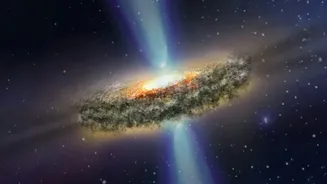
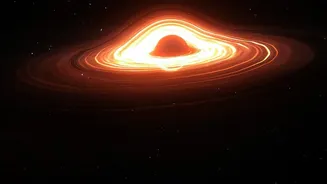
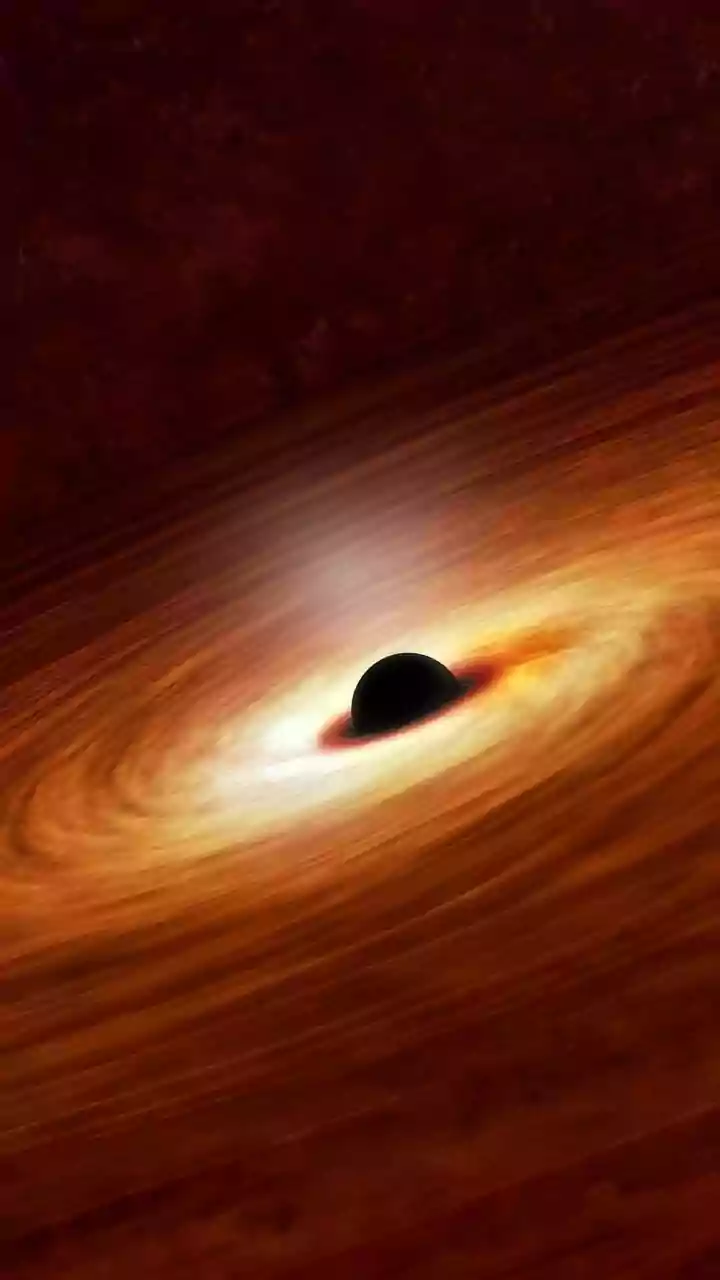
The telescope cannot see the black holes directly. Instead, scientists used an instrument called a Near-Infrared Spectrograph (NIRSpec) to perform integral field spectroscopy. This technique essentially dissects the light from every part of the galaxy, creating a detailed map. They were looking for 'broad-line regions,' a telltale signature of an actively feeding black hole. As immense amounts of gas and dust are pulled towards a black hole, they form a super-heated, chaotic disc. The material spins at incredible speeds, causing the light it emits to be smeared across a wide range of frequencies due to the Doppler effect. Finding this 'broad line' of light is like finding a fingerprint, confirming the presence of an active galactic nucleus (AGN) powered by a feasting black hole.
An Unexpected Cosmic Trio
While scientists might have expected to find one active black hole at the center of J0148-4214, the Webb data revealed something unprecedented for such a distant galaxy: evidence for three. The analysis showed two distinct broad-line regions huddled close together in the galaxy's center, separated by only about 620 light-years. A third active black hole was found further out, about 5,500 light-years from the central pair. This marks the first time a trio of actively accreting black holes has been identified in a single galaxy in the very early universe. The team was able to estimate their masses: a behemoth of 80 million solar masses, a mid-weight of 2 million, and a smaller one of about 600,000 solar masses.
A Story of Galactic Collision
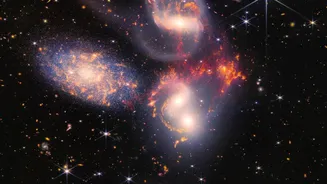
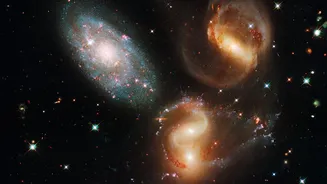
The presence of three active black holes strongly supports the theory of 'merger-led growth.' This idea proposes that in the crowded early universe, galaxies frequently collided and merged. When this happened, their central supermassive black holes would eventually find each other, sinking towards the new galactic center. The chaotic gravitational environment of a merger churns up huge amounts of gas and dust, providing a massive feast for all the black holes involved, causing them to grow rapidly. The scene at J0148-4214 is a direct confirmation of this violent but crucial process. We are likely witnessing the aftermath of two or three smaller galaxies crashing together, their black holes all lighting up as they consume the available fuel before an eventual merger.
Solving a Cosmic Growth Spurt
This discovery is so exciting because it helps solve the puzzle of how black holes got so big, so fast. While black holes can grow by steadily consuming gas, that process alone may be too slow to explain the giants seen in the first billion years of cosmic history. Finding this black hole triplet suggests that mergers were a common and highly efficient pathway for rapid growth. The two central black holes are expected to merge themselves in a few hundred million years, and the third may be on a path to sink inward as well. Each merger not only combines their mass but also sends powerful gravitational waves rippling across spacetime, events that future observatories may be able to detect. This single observation provides a powerful link between galaxy mergers, black hole growth, and the fundamental forces that shape our universe.