






A Small Satellite on a Big Mission
Pandora is not a giant, flagship observatory like the James Webb Space Telescope (JWST). Instead, it's a SmallSat, part of NASA's Astrophysics Pioneers program, which focuses on smaller, faster, and more affordable missions. Launched on January 11, 2026,
Pandora has now completed its initial checkout phase and is ready for its primary one-year mission. During this time, it will focus its attention on at least 20 known exoplanets, ranging in size from rocky 'super-Earths' to gas giants. The goal isn't to discover new planets, but to understand the ones we've already found in much greater detail.
The Starlight Contamination Problem
When scientists study a distant planet's atmosphere, they often use a technique called transit spectroscopy. As a planet passes in front of its star, a tiny fraction of starlight filters through its atmosphere. By analyzing this light, astronomers can look for the chemical 'fingerprints' of molecules like water. But there's a major complication: stars are not perfect, stable balls of light. They have active regions, like sunspots, that can make the star's own light vary. These variations can create false signals that mimic a planet's atmosphere or, conversely, hide the real signals scientists are looking for. This is known as stellar contamination, and it's one of the biggest challenges in characterising exoplanets.
Pandora’s Clever Solution
This is where Pandora's unique design comes in. To solve the contamination problem, the satellite will stare at its targets for long periods—about 24 hours per observation—and observe them simultaneously in two different kinds of light. An 18-inch telescope splits the light, sending visible light to one instrument and near-infrared light to another. The visible light data helps scientists track the star's activity, such as starspots rotating in and out of view. The infrared data contains the crucial information about the planet's atmosphere. By combining these simultaneous observations, astronomers can cleanly separate the star's signal from the planet's, leading to much more reliable atmospheric data.
A Scout for Bigger Telescopes
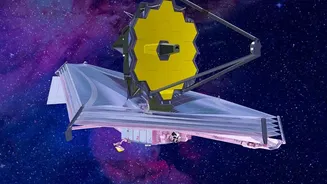
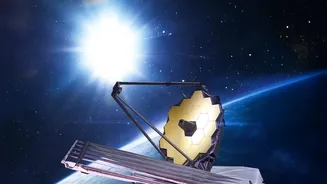
Pandora isn't designed to compete with the mighty JWST; it's designed to help it. The JWST is incredibly powerful, but its time is also in extremely high demand, so it can't afford to spend long hours just staring at a single star to average out its activity. Pandora, as a dedicated and cost-effective mission, can perform these long-duration observations to create a stable, clean dataset. This work helps identify the most promising and stable targets for follow-up studies by Webb and future observatories. In fact, Pandora's near-infrared detector is a spare part originally developed for the Webb telescope, creating a direct link between the two missions.