





The 50-Year Search Is Over
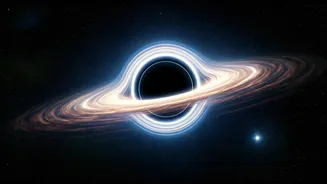
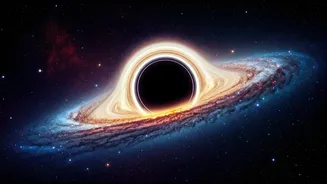
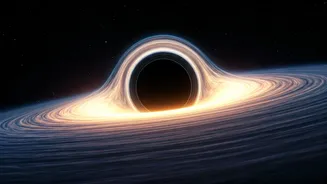
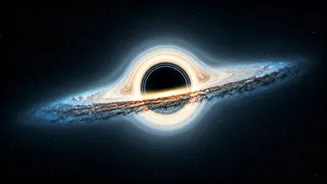
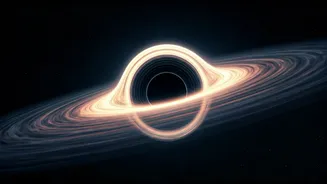
At the center of the Milky Way, 27,000 light-years from Earth, sits Sagittarius A (Sgr A), a supermassive black hole with the mass of four million suns. For more than half a century, astronomers have operated under a core assumption: as black holes devour
gas and dust, they must also expel a powerful outflow, or wind. Yet, despite its relative proximity, Sgr A appeared to be an exception. No one could find its wind, leading to a persistent astronomical puzzle. That is, until now. Researchers at Northwestern University have announced the first definitive evidence of this elusive wind, providing the most detailed view yet of the physics at play in our galactic center. "Unless a black hole exists in a perfect vacuum, it must blow a wind somehow," said Mark Gorski, who co-led the study. "With new observations, this is the first time we've had a clean enough view to see the wind's imprint."
The Minds Behind the Discovery
The breakthrough was led by Northwestern's Mark Gorski and Lena Murchikova, who each brought a unique approach to the problem. Gorski, a research assistant professor at the university's CIERA (Center for Interdisciplinary Exploration and Research in Astrophysics), specializes in the evolution of galaxies. Murchikova, an assistant professor of physics and astronomy, is an expert in black hole astrophysics, focusing specifically on Sgr A. Their collaboration combined Gorski's expertise in astrochemistry and data analysis with Murchikova's deep knowledge of our galactic center. "We were the first to show that molecular gas very, very close to the black hole is feeding it," Murchikova explained. Their combined effort showcases a modern, problem-oriented approach to astrophysics, using whatever tools are necessary to solve the universe's biggest questions.
Peering Through the Cosmic Haze
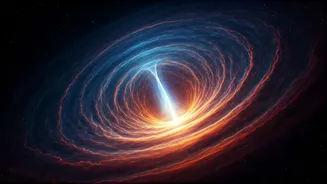
Observing the galactic center is notoriously difficult because we have to look through the dense plane of our own galaxy, a region thick with gas, dust, and stars. To get around this, the team used five years of incredibly deep observations from the Atacama Large Millimeter/Submillimeter Array (ALMA) in Chile. They created an image of the cold molecular gas around the black hole that was 100 times deeper and 80 times sharper than previous maps. By applying novel calibration methods to remove the overwhelming radio glare of the black hole itself, a stunning feature emerged from the data: a huge, cone-shaped cavity in the cold gas, about one parsec (three light-years) long. Gorski and Murchikova were, in their own words, "gobsmacked." This cavity was the smoking gun—an unmistakable imprint carved out by a hot, energetic wind.
Why This Wind Matters
To confirm their finding, the team overlaid their ALMA map with past X-ray data from NASA's Chandra X-ray Observatory. The data lined up perfectly, showing hot gas filling the exact cavity they had identified. The discovery does more than just solve a 50-year-old mystery. It confirms that Sgr A*, while relatively quiet compared to black holes in other galaxies, is not a bizarre outlier. "The wind is not powerful, and its direction probably wanders with time," Murchikova noted. "It shows that our black hole is not unique, and our place in the Universe is not unique." Studying this gentle wind gives scientists a rare window into the dominant, quiet state of most supermassive black holes across the cosmos, a state that is much harder to observe than the dramatic 'fireworks' of more active galaxies. This breakthrough provides a vital new understanding of how black holes interact with and shape their host galaxies over billions of years.