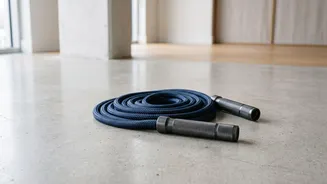








When it comes to cardio, running and jumping rope are two of the most popular choices. But beyond heart health, how do they stack up for improving balance and coordination? These two skills are vital not just for athletes, but for everyday movement.
The Steady Challenge of Running
Running
is a foundational human movement, and its benefits for coordination are tied to its repetitive, forward-propelling nature. The primary challenge in running is maintaining stability and efficiency over distance. Your body learns to coordinate the swing of your arms with the stride of your legs to maintain forward momentum and balance. This develops what can be called 'endurance coordination', the ability to sustain a consistent and efficient movement pattern for an extended period. While running, your brain and muscles work to control your center of gravity as you move from one foot to the other. This enhances intermuscular coordination, teaching opposing muscle groups like your quadriceps and hamstrings to work in harmony rather than against each other. The result is a smoother, more economical stride, which is crucial for both performance and injury prevention. However, this coordination is largely developed in a single plane of motion: forward.
The Dynamic Demands of Jumping Rope
Jumping rope presents a different, more complex coordination challenge. It is a full-body activity that demands precise timing between your hands, wrists, feet, and eyes. Unlike the linear motion of running, jumping rope is a plyometric exercise that happens largely in a fixed position. This requires constant, rapid-fire neuromuscular adjustments to maintain balance. Every single jump is a lesson in proprioception, which is your body's awareness of its position in space. You must land lightly on the balls of your feet, using your calves and ankles as springs, all while your wrists control the rope's speed and rhythm. This continuous feedback loop—jump, clear the rope, land, repeat—sharpens reflexes and agility in a way that steady-state running does not. Studies have shown that jump rope training significantly improves coordination, balance, and agility.
Coordination: Rhythm Versus Stride
The key difference in coordination between the two activities lies in rhythm versus stride. Running builds coordination through maintaining a consistent stride length and cadence over varied terrain. It's about efficiency in forward motion. Jumping rope, on the other hand, is a masterclass in rhythm and timing. It forces your upper and lower body to synchronize perfectly in a fast, repetitive cycle. A slight error in timing the flick of the wrist or the hop of the feet immediately stops the exercise, providing instant feedback that running doesn't offer. This makes jumping rope exceptionally effective for developing the kind of quick-footedness and hand-eye-foot coordination beneficial for sports like boxing, tennis, and basketball.
Balance: Stability Versus Agility
Both exercises improve balance, but they train different systems. Running enhances your single_leg stability as you push off one foot and land on the other, challenging your core and hip muscles to prevent your torso from rotating or tilting. It’s about maintaining balance while in motion. Jumping rope hones your reactive balance and static stability. By making you perform small, controlled jumps in a confined space, it strengthens the muscles around your ankles and knees, which are crucial for making rapid adjustments to prevent a loss of balance. Research has demonstrated that jumping rope enhances the body's ability to control balance in the trunk and lower limbs during movement. Think of it this way: running builds the balance needed to move forward powerfully, while jumping rope builds the balance needed to be light, agile, and reactive on your feet.
Which Is Better for You?
There is no single 'better' exercise; the right choice depends entirely on your fitness goals. If your aim is to build long_distance endurance and improve your efficiency for activities like marathons or trail running, then running is indispensable. It provides the specific training your body needs for that activity. If your goal is to boost overall athleticism, improve agility, quickness, and develop precise full_body coordination, jumping rope offers more benefits in a shorter amount of time. Many athletes find that the two activities are highly complementary. Jumping rope can serve as an excellent warm_up for a run, priming the neuromuscular system and improving the elasticity of lower_leg muscles, which may help reduce running_related injuries. Conversely, the aerobic base built from running can help you sustain longer, more intense jump rope sessions.