



Meet the Solar System's Largest Moon
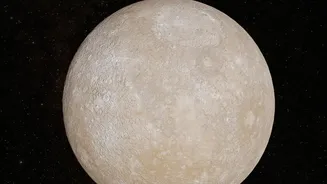
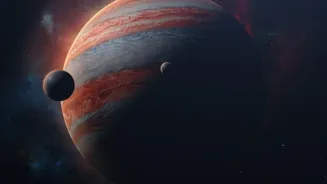
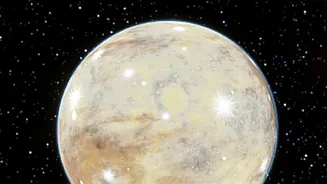
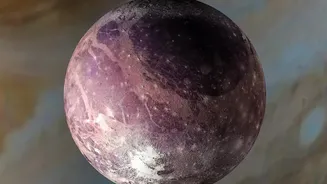
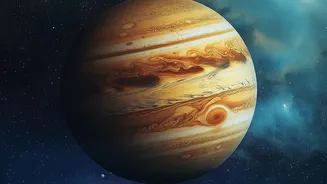
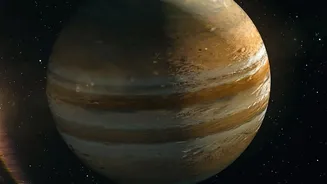
The celestial body in question is Ganymede, the largest of Jupiter’s many moons. In fact, with a diameter of over 5,260 kilometres, Ganymede is the largest moon in our entire solar system. It is bigger than the dwarf planet Pluto and even larger than the planet Mercury.
If it were orbiting the Sun instead of Jupiter, it would almost certainly be classified as a planet itself. Discovered by Galileo Galilei in 1610, Ganymede is one of four large moons known as the Galilean satellites. Its sheer size and complexity challenge our simple definitions of what a moon can be, making it one of the most compelling objects for astronomers to study.
An Ocean Hidden Beneath the Ice
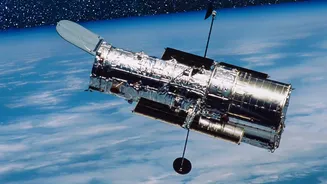
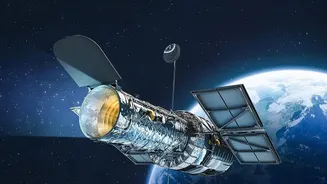
Ganymede’s most tantalizing secret lies beneath its frozen, cratered surface. Scientists have gathered strong evidence, primarily using the Hubble Space Telescope, to confirm the existence of a huge, saltwater ocean lurking below the moon’s icy crust. This isn't just a small pocket of water. It’s a global ocean estimated to be around 100 kilometres deep—ten times deeper than any ocean on Earth. It’s believed that Ganymede's hidden ocean contains more water than all of Earth's oceans combined. The source of this evidence comes from observing Ganymede's aurorae, or northern lights. The way these lights rocked back and forth suggested the influence of a large, electrically conductive saltwater ocean beneath the ice.
More Than Just a Moon
Beyond its size and subterranean sea, Ganymede boasts another feature that makes it exceptionally planet-like: it is the only moon in the solar system known to have its own magnetic field. This field is generated by its molten iron core, similar to how Earth generates its own protective magnetic bubble. This creates a small magnetosphere for Ganymede, which is then embedded within Jupiter's much larger and more powerful one. The surface of Ganymede is a mix of old, dark, heavily cratered regions and younger, lighter, grooved terrains, suggesting a complex geological history. These features point to a world that has been, and may continue to be, internally active.
A Candidate for Extraterrestrial Life?
Anywhere we find liquid water, the question of life is not far behind. Ganymede possesses water, a potential energy source from tidal flexing caused by Jupiter's gravity, and the necessary chemical building blocks. However, its potential for life may be different from its famous sibling, Europa. Europa’s ocean is believed to be in direct contact with a rocky seabed, creating the potential for hydrothermal vents similar to those on Earth's ocean floors, which teem with life. On Ganymede, scientists theorize the ocean may be sandwiched between layers of ice, potentially limiting the interaction between water and rock nutrients. This makes Ganymede a different kind of ocean world, one that expands our understanding of where habitable environments might exist.
The Future of Exploration
The mysteries of Ganymede and its sibling moons will not remain out of reach for much longer. The European Space Agency's JUICE (Jupiter Icy Moons Explorer) mission is already on its way to the Jovian system, scheduled to arrive in 2031. After studying Europa and Callisto, its grand finale will be to enter orbit around Ganymede, making it the first spacecraft to orbit the moon of another planet. At the same time, NASA's Europa Clipper mission, arriving in 2030, will conduct dozens of flybys of Europa to investigate its habitability. Together, these missions promise to revolutionize our understanding of these incredible ocean worlds, turning science fiction concepts into scientific fact.