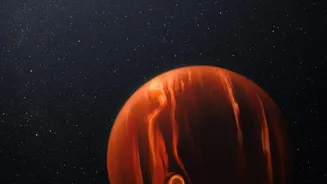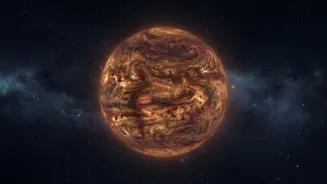








Scattered across the cosmos are mysterious objects that blur the line between planets and stars. They are known as brown dwarfs—often called 'failed stars'—and they hold clues to how both solar systems and stars form, live, and die.
The Cosmic Middle Ground
Imagine an object more
massive than Jupiter, our solar system's largest planet, yet not quite massive enough to become a star. That's a brown dwarf. They form from collapsing clouds of gas and dust, just as stars do. However, they never accumulate enough material to kickstart the process that defines a star. While a star like our Sun is a self-sustaining nuclear furnace, a brown dwarf is more like a cosmic ember, glowing faintly from the leftover heat of its formation. Their mass typically ranges from about 13 to 80 times that of Jupiter. Below this range, you have a planet; above it, you have the smallest, dimmest stars known as red dwarfs.
The All-Important Fusion Threshold
The defining characteristic of a star is its ability to sustain nuclear fusion in its core. The immense gravitational pressure at the centre of a star crushes hydrogen atoms together to form helium, releasing a tremendous amount of energy in the process. This outward push of energy perfectly balances the inward pull of gravity, creating a stable, shining star that can last for billions of years. This process requires a colossal amount of mass to generate the necessary core temperature and pressure. The minimum threshold for this self-sustaining hydrogen fusion is estimated to be about 80 times the mass of Jupiter, or about 8% of the Sun's mass.
Why Brown Dwarfs Fail to Ignite
This is where brown dwarfs fall short. They simply don't have the gravitational might to ignite and sustain the fusion of ordinary hydrogen. Their cores never reach the extreme temperatures and pressures needed. While some of the most massive brown dwarfs can briefly fuse a heavier isotope of hydrogen called deuterium, this fuel source is rare and runs out quickly, often within a few million years. Once this brief phase is over, the brown dwarf simply cools down for the rest of its existence, slowly fading into the darkness of space and glowing only in infrared light. This inability to create a stable, long-term energy source is why they earn the 'failed star' moniker.
Enter NASA's SPHEREx Mission
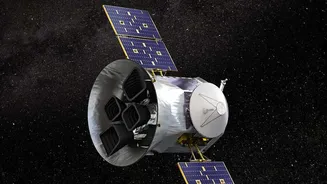
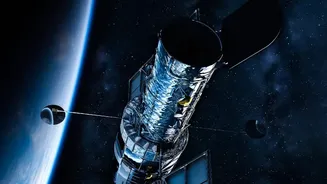
Because brown dwarfs are so cool and dim, they are incredibly difficult to detect. This is where NASA’s Spectro-Photometer for the History of the Universe, Epoch of Reionization, and Ices Explorer (SPHEREx) mission comes in. Launched in March 2025, SPHEREx is a space telescope designed to survey the entire sky in near-infrared light—a part of the spectrum invisible to the human eye but perfect for spotting faint, warm objects like brown dwarfs. Over its twoyear mission, SPHEREx is creating a comprehensive map of the cosmos in 102 different colour bands, providing an unprecedented amount of data on hundreds of millions of objects.
Unlocking Atmospheric Secrets
The SPHEREx mission is a gamechanger for understanding these celestial misfits. By studying the light from thousands of brown dwarfs, scientists can analyse their atmospheric composition. Early findings from the mission have already revealed chemically rich atmospheres containing water, methane, carbon monoxide, and carbon dioxide. This data helps astronomers understand the atmospheric processes on these objects, which appear to be complex and variable. By mapping the distribution and characteristics of brown dwarfs, SPHEREx is helping scientists piece together the puzzle of star and planet formation, searching for key ingredients for life, and refining our understanding of these enigmatic worlds that drift alone in the dark.