





A New Eye on the Cosmos
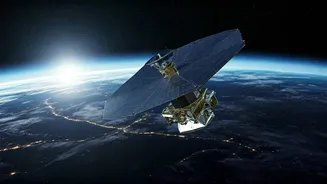
Set to launch as early as August 30, 2026, the Nancy Grace Roman Space Telescope represents the next generation of space-based observatories. Named after NASA's first chief of astronomy, Nancy Grace Roman, the telescope is designed to build on the legacies
of predecessors like the Hubble Space Telescope. It features a primary mirror that is 2.4 meters (7.9 feet) in diameter, the same size as Hubble's. However, its key advantage lies in its extraordinary field of view. The telescope's Wide Field Instrument will be able to capture an area of the sky at least 100 times larger than Hubble can in a single image. This capability will allow Roman to map the sky with incredible speed and efficiency, creating vast, panoramic views of the universe in Hubble-like resolution.
Hunting for Dark Energy and New Worlds
Roman has two primary scientific goals that place it at the forefront of modern astrophysics. Firstly, it will investigate the nature of dark energy, the mysterious force believed to be causing the accelerated expansion of the universe. By surveying billions of galaxies, the telescope will create a massive 3D map of the cosmos, allowing scientists to study how the universe has evolved and test theories about dark energy's influence. Secondly, Roman will conduct a massive search for exoplanets, planets orbiting stars outside our solar system. It will use a technique called gravitational microlensing, which can detect planets from thousands of light-years away, down to masses smaller than Earth's. The mission is expected to find thousands of new worlds, providing a statistical census of planetary systems throughout our galaxy.
The Right Rocket for the Job
To reach its destination, a stable orbit about 1.5 million kilometers from Earth known as the second Lagrange point (L2), the Roman Space Telescope needs a powerful ride. NASA awarded the launch contract to SpaceX for its Falcon Heavy rocket. As one of the world's most powerful operational rockets, the Falcon Heavy has the capability to send the nearly 4,200-kilogram observatory on its long journey. The contract, valued at approximately $255 million, secures a critical step for the mission. The choice of Falcon Heavy underscores the growing reliance on commercial launch providers for flagship science missions, a partnership that blends NASA's scientific direction with the innovation of the private space industry.
A Pioneer in Technology
Beyond its main survey instrument, Roman will also test a new piece of technology called a coronagraph. This instrument is designed to block the overwhelming glare from a star, making it possible to directly image faint planets orbiting it. While considered a technology demonstration, the coronagraph on Roman will be 100 to 1,000 times more sensitive than previous similar instruments in space. It will pave the way for future missions that aim to take direct pictures of Earth-like planets, potentially analyzing their atmospheres for signs of life. This makes Roman not just a mission of discovery, but a crucial stepping stone for the next frontier of exoplanet exploration.