







A 'Third Eye' in Geosynchronous Orbit
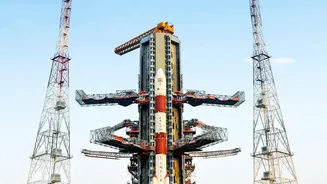
The Indian Space Research Organisation (ISRO) successfully launched the EOS-05 satellite aboard a GSLV-F17 rocket from the Satish Dhawan Space Centre in Sriharikota on September 4, 2026. What makes this mission truly historic is its destination: a geosynchronous
orbit approximately 36,000 km from Earth. Unlike previous Earth observation (EO) satellites that circle the planet in low-Earth orbits and revisit a location periodically, EOS-05 remains in a fixed position relative to the Earth. This allows it to continuously monitor the Indian subcontinent and surrounding areas, turning what was once a series of snapshots into a near real-time video feed for strategic purposes. Weighing over 2,300 kg, it is one of the heaviest satellites launched by a GSLV rocket, demonstrating ISRO's growing capability in heavy payload missions.
Game-Changer for Disaster Management
One of the most significant applications of EOS-05 is its ability to radically improve disaster management. With its advanced imaging sensors, the satellite can provide rapid, large-scale updates on fast-developing natural disasters like cyclones, floods, and forest fires. By imaging the entire Indian subcontinent roughly every 30 minutes and specific priority areas even more frequently, it provides authorities with invaluable data for planning evacuations, coordinating response efforts, and assessing damage in the aftermath. This constant watchfulness is crucial for a country that frequently faces extreme weather events, allowing for more effective and timely interventions that can save lives and resources.
Enhancing National Security
Beyond civilian uses, EOS-05 provides a significant strategic advantage. Its persistent stare capability offers a powerful tool for monitoring India's borders and maritime interests. The ability to track changes and movements in real-time enhances situational awareness for security forces. While ISRO's EO satellites have always had dual-use capabilities, the geosynchronous nature of EOS-05 provides an unprecedented level of surveillance. ISRO officials have highlighted that the satellite is crucial for continuously monitoring India and its surrounding areas, serving vital security and safety functions for the nation.
A Boost for Agriculture and Environment
The satellite's applications extend to crucial sectors like agriculture, forestry, and environmental monitoring. Data from EOS-05 can help in assessing crop health over large areas, monitoring soil moisture, and managing water resources more efficiently. It will also contribute to tracking environmental changes, such as the impact of climate change on vegetation and water bodies. These capabilities align with the broader goals of ISRO's Earth Observation programme, which has consistently provided vital data for national development for decades.
Redemption and Self-Reliance
The successful launch of EOS-05 is also a story of resilience for ISRO. It comes after previous setbacks, including the failure of the similar GISAT-1 mission in 2021. This success, using the powerful GSLV rocket, re-establishes the reliability of India's heavy-lift launch platform, which is critical for future ambitious projects like the Gaganyaan human spaceflight mission. Prime Minister Narendra Modi and other officials praised the mission as a reflection of India's growing self-reliance and the successful partnership between ISRO and private industry, which is poised to play a larger role in India's space ecosystem.