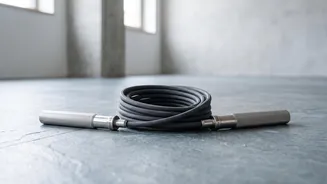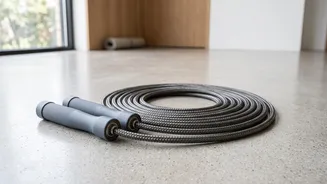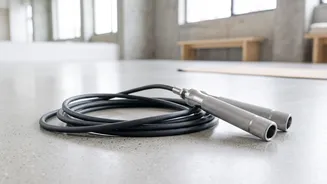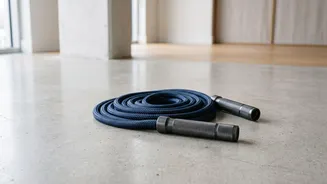








Running and jumping rope are two of the most accessible cardio workouts, both praised for enhancing coordination. But they don't train the body in the same way. The differences in how they develop the connection between your arms and legs are significant.
The Rhythm of the Rope
Jumping rope is fundamentally an exercise in rhythm and timing. Your hands, wrists, and feet must work together in a precise, repeating sequence. If your timing is off even slightly, the feedback is immediate—the rope catches your feet, and the movement stops. This constant feedback loop rapidly trains the neuromuscular system. It forces the brain to synchronise the circular motion of the arms and wrists with the vertical jump of the legs. This is a highly specific type of coordination that involves whole-body rhythm, hand-eye coordination, and timing, making it a powerful tool for developing motor skills.
The Forward Motion of Running
Running, in contrast, is built on a foundation of reciprocal, or alternating, motion. As your right leg moves forward, your left arm swings forward to counterbalance, and vice versa. This cross-body pattern is a more natural, ingrained human movement than the demands of jump rope. The coordination required for running is about maintaining balance and efficiency while propelling the body forward. It involves the complex interaction of muscles and joints to create a smooth, economical gait. While it certainly requires coordination, it doesn't have the same strict, immediate-feedback rhythm as jumping rope. The learning curve is much lower for most people because the basic pattern is innate.
Upper and Lower Body Integration
Herein lies a major distinction. Jump rope is a true full-body workout where the upper and lower body are actively and equally essential to performing the movement. The shoulders, arms, and wrists are not passive; they are actively controlling the rope, which requires strength and endurance. This makes it a superior exercise for developing coordination that integrates the entire body in a single, unified action. Running is primarily a lower-body dominant activity. While the arms do swing to provide balance and some propulsive assistance, their role is secondary compared to the work being done by the glutes, quads, hamstrings, and calves. Therefore, the coordination demand is heavily biased towards the lower body and core stability.
Cognitive Load and Neuromuscular Learning
The cognitive demand of jumping rope, especially for beginners, is significantly higher than running. You must consciously think about turning the rope, timing the jump, and maintaining a steady rhythm. This active participation from the nervous system promotes adaptive responses in the central nervous system, effectively 'upgrading' your body's control systems. Running, for most people, can be done with much less conscious thought once a basic level of fitness is achieved. Its coordination demands are more about optimising an existing pattern for efficiency rather than learning a new, complex motor skill from scratch. This is why experienced runners can often 'zone out', whereas even skilled jump ropers must maintain a high level of focus.
Impact and Proprioceptive Feedback
Both activities are high impact, but the nature of impact differs. Correct jump rope form involves small, light jumps on the balls of feet, which can be a lower impact activity than running if done correctly. This repetitive, controlled landing strengthens muscles and connective tissues around ankles and knees, enhancing proprioception—your body awareness of its position in space. Running involves a greater variety of forces as your body moves forward with each footstrike absorbing full body weight unilaterally. This also builds proprioceptive awareness but forces are less predictable and can be harder on joints depending on terrain and form.