






Beyond a Simple Sphere
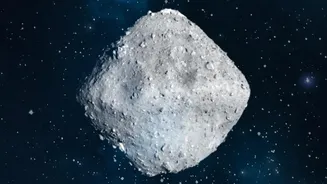
For years, many simulations for deflecting an asteroid treated the target as a perfect sphere. It made the complex calculations manageable. The problem, as one Sandia National Laboratories physicist noted, is that 'spherical asteroids don't exist'. Real
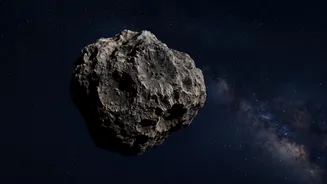
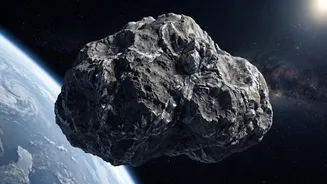
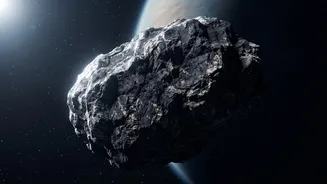
near-Earth objects are lumpy, irregular, and varied, ranging from solid metallic bodies to loose collections of rubble held together by gravity. This reality was often set aside to simplify the enormous challenge of modeling an impact. But as our understanding has grown, so has the realization that this simplification could be a critical flaw in our planetary defense planning. The DART mission in 2022, which successfully impacted the asteroid Dimorphos, showed just how complex these bodies can be, with the impact dramatically reshaping the target. This highlighted the urgent need for models that can account for reality.
A Breakthrough in Simulation
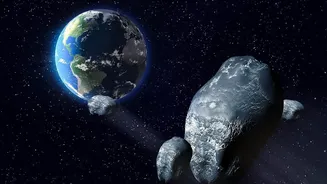
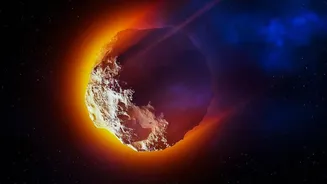
To tackle this problem, researchers at Sandia National Laboratories developed a powerful new computer model. This breakthrough combines two different simulation systems to create the most detailed asteroid deflection model to date. The new algorithm is reportedly over 1,600 times faster than previous methods, finally giving scientists the computational power to move beyond simple spheres and model asteroids in their true, irregular forms. The model allows researchers to upload detailed 3D shapes of actual asteroids, captured from spacecraft flybys, and then simulate what would happen if we tried to nudge it. They can simulate a nearby nuclear detonation, which would use a powerful burst of X-rays to heat one side of the asteroid, causing material to vaporize off the surface and create a push, like a makeshift rocket engine.
Why Aiming Is Everything
The results of these new simulations were startling. The researchers found that an asteroid's irregular shape dramatically affects how it responds to a defensive blast. In one simulation, hitting one side of an asteroid produced a change in velocity that was nearly five times greater than hitting another side. The study's lead researcher, Nathan Moore, said, 'We expected aim to matter. What surprised us was how much'. This happens because a lumpy, uneven surface with ridges and valleys vaporizes material unevenly when hit with X-rays. A blast directed at a concave 'bowl' shape might be less effective than one hitting a flat or convex surface. The simulations also showed that the asteroid's spin could be changed dramatically—by a factor of 17 in one case—depending on the impact point. This is a crucial factor, as the goal is to deflect the threat, not send it tumbling uncontrollably or, even worse, break it into multiple hazardous pieces.
From Rubble Piles to Watermelons
The challenge is compounded by what we know about asteroid composition. Many asteroids, including the DART mission's target Dimorphos, are not solid rocks but 'rubble piles'—loose collections of boulders and dust. Hitting such a body is less like hitting a billiard ball and more like punching a beanbag. The impact from the DART spacecraft, for instance, didn't just leave a crater; it was so effective that it changed Dimorphos's shape from a squashed ball into something resembling an oblong watermelon. The impact ejected about 1% of the asteroid's total mass into space, and the recoil from that debris provided a momentum boost 3.6 times greater than that of the spacecraft itself. This 'momentum enhancement' is a huge factor, but it depends entirely on the surface properties and shape of the target.
Smarter Defense for a Safer Future
This research doesn't mean we are powerless; it means that effective planetary defense requires more intelligence and precision than previously assumed. It underscores the importance of reconnaissance missions, like the upcoming Hera spacecraft from the European Space Agency, which will visit Dimorphos to study the aftermath of the DART impact in detail. Before attempting to deflect a potentially hazardous object, we first need to understand its specific shape, rotation, and composition. With better data and advanced simulations like those from Sandia, emergency planners can run scenarios for specific known asteroids. They can determine the optimal place to aim a kinetic impactor or direct a nuclear burst to achieve a safe deflection without accidentally making the situation worse. Picking the right side to target could be the difference between success and failure.