





A Celestial History Book
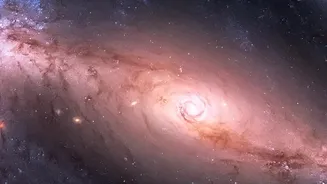
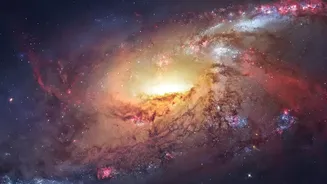
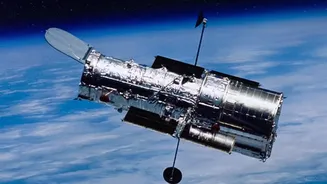
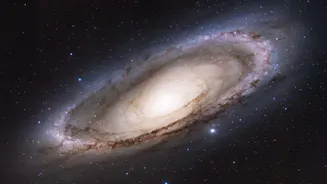
Imagine being able to read the history of an entire galaxy just by looking at its stars. That's the stunning achievement a team of astronomers has unlocked using data from NASA's Hubble Space Telescope. By meticulously mapping about two-thirds of the Andromeda
galaxy's sprawling disk, they have created a tool that functions as a timeline, revealing the galaxy's star-making story over the last half-billion years. The project combines two massive Hubble surveys, the Panchromatic Hubble Andromeda Treasury (PHAT) and its southern counterpart, PHAST. Together, they provide an unprecedentedly sharp view of roughly 200 million individual stars within our closest large galactic neighbor.
How to Read Galactic Time
So how exactly does a star map become a timeline? The secret lies in the stars themselves, which act as a 'fossil record' of a galaxy's past. Astronomers can determine the age of different stellar populations by their color. Massive, hot stars burn through their fuel quickly and shine with a brilliant blue light, signaling recent star birth. In contrast, smaller, cooler, and longer-lived stars glow red, indicating an older population. By dividing the vast Hubble image of Andromeda into thousands of smaller sections and analyzing the ratio of blue to red stars within each, scientists can reconstruct where and when stars formed. This allows them to effectively rewind time, watching the ebbs and flows of cosmic creation.
A Story of Decline
The 500-million-year timeline tells a compelling story of a galaxy winding down. The data shows that star formation in Andromeda has been steadily declining over this entire period. Five hundred million years ago, Andromeda was churning out new stars at a rate equivalent to about one of our sun's mass every year. But that activity has slowed dramatically. By 40 million years ago, the rate had been cut in half, and today it has plummeted to just one-fifth of a solar mass per year. This slowdown is not happening uniformly; it is most pronounced in a huge, 32,000-light-year-wide ring where much of the galaxy's star formation has traditionally occurred.
A Glimpse of Our Own Future?
Andromeda isn't running out of the gas and dust needed to make stars. Instead, astronomers believe it's in a natural slowdown phase after a major burst of star birth about 2 billion years ago, which was likely triggered by a merger with a smaller galaxy. Understanding this evolution is crucial, not just for learning about Andromeda, but for contextualizing our own Milky Way. Since the Milky Way and Andromeda are on a cosmic collision course, set to merge in about 4.5 billion years, studying our neighbor's life cycle offers a preview of the long-term evolutionary path for large spiral galaxies like ours. This deep historical view of Andromeda helps complete the story of how galaxies grow, age, and eventually fade.